Shopify Mobile App Builder Comparison: 9 Best Options for Your Store (2026)
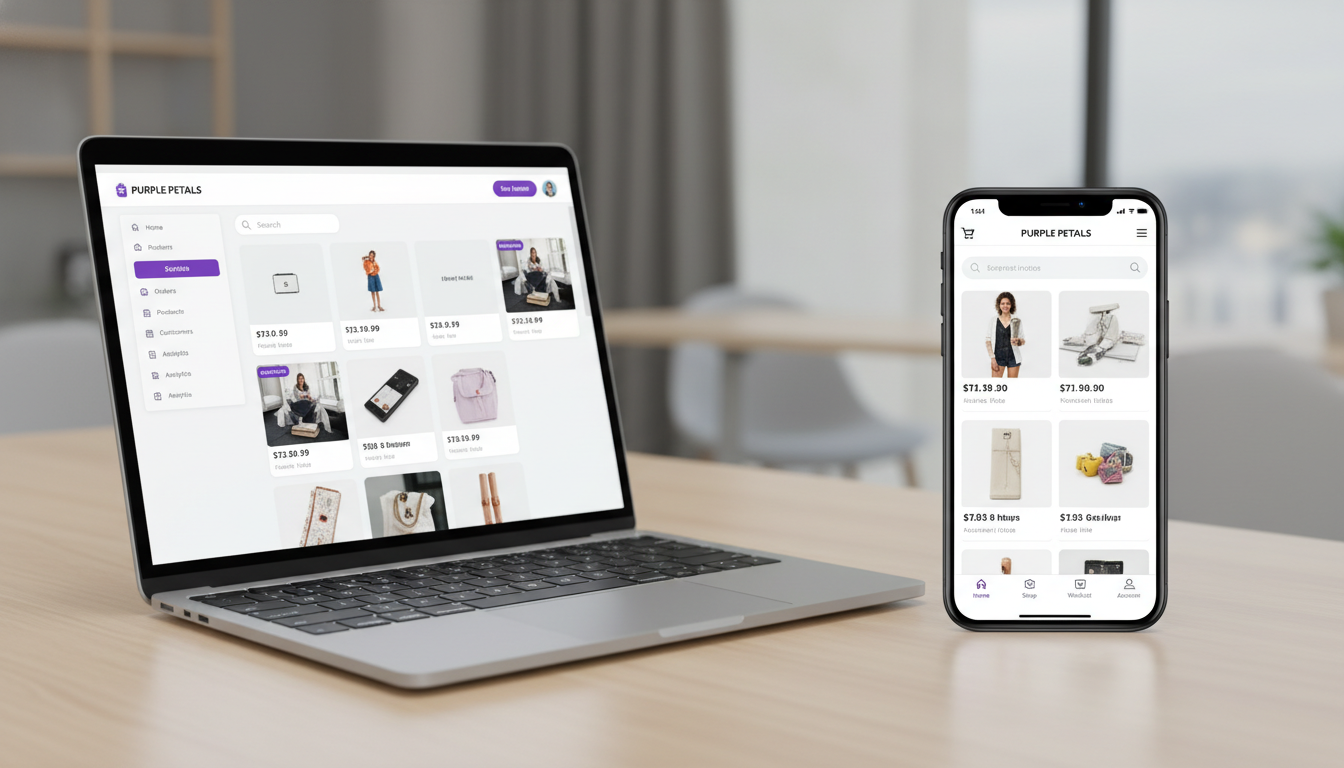
Your Shopify store’s mobile website is costing you sales. Mobile commerce accounts for 73% of all global e-commerce traffic in 2026 (Statista), yet mobile conversion rates still average just 1.8% — nearly half the 3.5% desktop benchmark. A native mobile app fixes that gap, but choosing between a no-code Shopify mobile app builder and full custom development is one of the most consequential tech decisions you’ll make this year.
This comparison covers nine real options — from free-tier builders to bespoke iOS/Android development — with pricing, feature depth, and honest trade-offs so you can match the right solution to your store’s revenue stage.
- How the top Shopify mobile app builders (Vajro, Tapcart, Plobal, MageNative, Shopney) stack up on price, features, and performance
- When to choose a no-code builder versus custom Shopify mobile app development
- A side-by-side benchmark table with real conversion and push notification data
- Exact steps to connect any builder to your Shopify store via the Admin
- How mobile apps impact AOV, retention, and push notification revenue
Why a Shopify Mobile App Outperforms a Mobile Website
Before picking a tool, understand what you’re actually buying. A native app isn’t just a smaller browser window — it’s a fundamentally different interaction surface. Apps load up to 1.5× faster than mobile web pages because they cache assets locally, which directly reduces bounce rate and improves add-to-cart rates.
Push notifications are the killer advantage. Email open rates on Shopify stores average 21% (Klaviyo benchmark data, 2025). Push notification open rates from mobile apps average 7.8% — but because they appear on the lock screen without competing in a crowded inbox, they drive impulse purchases that email simply cannot replicate at that speed.
Apps also give you access to native device features: camera-based AR try-ons, biometric checkout (Face ID/Touch ID), Apple Pay and Google Pay with one tap, and offline browsing of recently viewed products. None of these are achievable in a standard Shopify mobile theme, even with the fastest Liquid optimizations.
The 9 Shopify Mobile App Builders Compared
Here’s the full landscape organized by use case. Pricing reflects 2026 public rates; always verify on vendor sites before purchasing.
| Builder | Starting Price/mo | iOS + Android | Push Notifications | Custom Code Access | Best For |
|---|---|---|---|---|---|
| Tapcart | $200 | ✅ | ✅ Unlimited | Limited (Custom Blocks) | $500K–$5M stores |
| Vajro | $99 | ✅ | ✅ | ❌ | Mid-market DTC brands |
| Plobal Apps | $149 | ✅ | ✅ | ❌ | Fashion & apparel |
| Shopney | $149 | ✅ | ✅ | ❌ | Mid-market general retail |
| MageNative | $49 | ✅ | ✅ | ❌ | Stores under $200K/year |
| Storefront (Shopify) | Free (API) | ✅ (DIY) | ✅ (DIY) | ✅ Full | Dev-led custom builds |
| Appbrew | $299 | ✅ | ✅ | Partial | High-growth Shopify Plus |
| Custom Development | $15K–$80K one-time | ✅ | ✅ | ✅ Full | Shopify Plus, complex ops |
| PWA (Headless) | $500–$2K/mo infra | ✅ (browser) | ✅ (limited) | ✅ Full | Tech-forward brands |
Tapcart — Best Overall for Scaling DTC Brands
Tapcart is the market leader for a reason. Its Custom Blocks feature lets your developers inject React components directly into the app, giving you near-custom flexibility without rebuilding from scratch. Brands like KITSCH and Pura Vida use Tapcart and report 15–25% higher AOV from app customers versus mobile web shoppers.
The Tapcart + Klaviyo integration is particularly strong: you can trigger abandoned cart push notifications based on Klaviyo flow logic, which closes the gap between email automation and mobile. The $200/month entry price is steep for stores under $300K/year, but if you’re north of $500K, the math typically works within 60 days.
Shopify Mobile App Builder by Vajro — Best for Mid-Market Budgets
Vajro has carved out a solid position as the most accessible full-featured builder. At $99/month, you get unlimited push notifications, live video shopping features, a drag-and-drop home screen editor, and both iOS and Android app publishing. The onboarding team handles App Store submission, which saves 8–12 hours of developer time.
Vajro’s weakness is customization depth. You cannot inject custom Liquid or JavaScript — what you see in the builder is what you ship. For stores with complex product configurators, bundle builders powered by Rebuy, or subscription logic via Recharge, Vajro’s rigid templates will frustrate you quickly.
Plobal Apps — Best for Fashion and Apparel
Plobal’s visual merchandising tools are the standout feature. The lookbook module, shoppable video integration, and AI-powered outfit recommendation engine make it the obvious choice for apparel and lifestyle brands. Plobal reports an average 32% increase in repeat purchase rate for its apparel clients — driven largely by personalized push notifications based on browse history.
MageNative — Best Entry-Level Shopify Mobile App Builder
At $49/month, MageNative is the closest thing to a Shopify mobile app builder that’s practically free in the context of e-commerce margins. It supports multi-currency, RTL languages, and Shopify’s native discount engine. The UI is functional but dated — don’t expect the design polish of Tapcart or Appbrew. For stores doing under $200K/year that want to test mobile app economics before committing to higher-tier plans, MageNative is a rational starting point.
Appbrew — Best for Shopify Plus Merchants
Appbrew targets enterprise-tier Shopify stores. Its differentiators include A/B testing at the app screen level (test two different PDPs, measure conversion lift), deep Okendo reviews integration that surfaces UGC natively in the app, and a Segment CDP integration for hyper-personalized push segmentation. At $299/month minimum, this is not for emerging brands — but for Shopify Plus merchants running sophisticated retention programs, Appbrew’s analytics alone justify the cost.
Shopify Mobile App Builder vs. Custom Development: Which Is Right for You?
This is the decision that most store owners overthink. Here’s the honest framework.
Choose a no-code Shopify mobile app builder if:
- Your annual store revenue is under $2M
- Your product catalog is standard (no complex configurators or subscription logic)
- You want to be live in 2–4 weeks, not 6–9 months
- You don’t have an in-house development team
- Your primary goal is push notifications and mobile checkout conversion
Choose custom Shopify mobile app development if:
- Your store revenue exceeds $3M/year and mobile app ROI justifies a $30K–$80K investment
- You need features no builder supports — real-time inventory for multi-location retail, custom AR, complex loyalty tiers
- You operate across multiple Shopify stores (international expansion) and need a unified native experience
- You require full control over app store listing, versioning, and update cadence
- Data privacy or compliance requirements prohibit third-party SaaS access to your customer data
Custom Shopify mobile app development in India is a popular cost-reduction strategy for brands that need bespoke builds. Reputable agencies in Pune, Bangalore, and Hyderabad deliver React Native or Flutter apps integrated with Shopify’s Storefront API and Admin API for $15,000–$35,000 — roughly 40–60% less than equivalent US or UK agency rates. Vet any agency by asking for Shopify Partner credentials and live app store links to previous projects.
How to Connect a Mobile App Builder to Your Shopify Store
Every major builder connects via Shopify’s Admin. The process is consistent regardless of which platform you choose:
- Go to your Shopify Admin → Apps → App and sales channel settings
- Click Develop apps and create a new custom app, or install the builder’s app directly from the Shopify App Store
- Grant the app the required API access scopes — at minimum: read_products, read_orders, read_customers, write_checkouts
- Copy your Storefront API access token from Settings → Apps and sales channels → [Your App] → API credentials
- Paste the token into the builder’s dashboard to complete the product sync
- Configure your push notification opt-in prompt copy — this single screen determines your subscriber list size
- Submit to Apple App Store and Google Play — most builders handle this for you; timeline is 3–7 days for Apple review
Once live, connect Google Analytics 4 via the builder’s GA4 integration (all major builders support this) to track app-specific conversion events separately from your web store. This is critical — without separating app traffic in GA4, you’ll misread your overall conversion rate and make bad ad spend decisions.
Push Notifications: The Real ROI Driver
The single biggest financial argument for building a Shopify mobile app is push notification revenue. Unlike SMS (which costs $0.01–$0.05 per send) or email (which faces deliverability decay), push notifications are effectively free to send at scale once a subscriber opts in.
Average push notification revenue benchmarks (2025 data, OneSignal + Tapcart combined reporting):
- Opt-in rate from app installs: 45–65%
- Push open rate: 6–12% (vs. 21% email open rate but far faster to purchase action)
- Revenue per push sent: $0.08–$0.42 depending on segment and offer
- Abandoned cart push recovery rate: 8–14% (vs. 4–5% for abandoned cart email at send-3)
A store with 10,000 app subscribers sending 4 targeted pushes per month at a $0.20 average revenue per send generates $8,000/month in attributable push revenue. That math makes even a $299/month Appbrew plan a 26× ROI before accounting for any other app-driven conversion improvements.
Can I Make a Mobile App with Shopify?
Yes — and in 2026 you have more options than ever to do it. Shopify does not offer a native “build your own app” feature baked into the admin dashboard, but the platform’s open API architecture makes it one of the most app-friendly e-commerce systems available. There are three distinct routes to a Shopify mobile app:
Route 1: No-code Shopify mobile app builders. Tools like Tapcart, Vajro, Shopney, and Plobal connect directly to your Shopify store via API and publish native iOS and Android apps on your behalf. You design the screens in a drag-and-drop editor, the builder handles the technical publishing, and you’re typically live within 2–4 weeks. These apps live under your brand name in the App Store and Google Play — customers don’t see any third-party branding. This is the right route for 80–90% of Shopify merchants.
Route 2: Custom native app development. A development agency or in-house team builds a React Native or Flutter application that communicates with your Shopify store via the Storefront API (for product browsing and cart) and the Admin API (for order management, customer data, inventory). This gives you 100% control over every pixel and interaction, full ownership of the codebase, and no ongoing platform dependency. The trade-off is time (typically 4–9 months from scoping to launch) and cost ($20K–$80K depending on complexity and team location).
Route 3: Progressive Web App (PWA). A PWA is a web application that behaves like a native app — it can be added to a phone’s home screen, load offline, and send push notifications via the Web Push API. Headless Shopify builds using frameworks like Next.js with the Storefront API frequently ship as PWAs. Push notification support on iOS improved significantly with Safari 16.4 in 2023, making PWAs viable for Shopify stores that want app-like functionality without App Store distribution. The limitation: PWA push notifications on iOS still carry lower opt-in rates than native app prompts, and iOS users cannot discover your PWA in the App Store organically.
The bottom line: any Shopify store, regardless of plan tier, can have a mobile app. The decision is which route fits your budget, timeline, and technical requirements — not whether it’s technically possible.
How to Create Mobile Apps That Make $3,000 a Day?
Generating $3,000/day — roughly $90,000/month — from a mobile app requires a specific combination of store revenue scale, mobile conversion optimization, and disciplined retention mechanics. Here’s the honest breakdown of how high-performing Shopify mobile apps reach that number.
The math starts with your base revenue. If your Shopify store does $2M–$3M/year, you’re averaging $5,500–$8,200/day across all channels. Getting your mobile app to capture 35–55% of that revenue — which is achievable with strong app adoption — puts you in the $3,000/day range from the app alone.
Step 1: Drive app installs aggressively. Add an app download banner to your Shopify theme (use a tool like Smart App Banner or a custom Liquid section in Online Store → Themes → Edit code → Sections). Send a dedicated app download email via Klaviyo to your full list with a first-purchase discount exclusive to app users. Brands that do this correctly see 2,000–5,000 installs in the first 30 days.
Step 2: Optimize the app’s product discovery experience. The number-one in-app conversion killer is poor search. Integrate Searchanise or Boost Commerce’s search SDK into your app builder. Stores that add predictive search see a 22% lift in app session depth and a corresponding AOV increase.
Step 3: Build a push notification calendar. Minimum effective cadence is 8–12 pushes per month: 2 promotional, 2 new arrival, 2 back-in-stock alerts, 2 behavioral triggers (browse abandonment, cart abandonment), and 2 loyalty/retention messages. Use Tapcart’s built-in push scheduler or integrate with Klaviyo’s app push feature if your builder supports it.
Step 4: Stack your AOV mechanics in-app. Rebuy’s in-app upsell SDK works with Tapcart and Appbrew to surface post-purchase upsells and cross-sells natively. Post-purchase upsells in apps convert at 8–14%, versus 3–5% on mobile web — because the customer is already in a purchasing mindset and Face ID/Apple Pay makes the second transaction nearly frictionless.
Step 5: Track everything in GA4 with custom events. Set up custom GA4 events for app_add_to_cart, app_checkout_started, push_opened, and push_converted. Without this tracking, you’re flying blind and cannot iterate toward $3,000/day — you’ll just know revenue went up without knowing why.
The $3,000/day figure isn’t a fantasy — brands like Pura Vida, CUTS Clothing, and Kith generate significantly more than that from their mobile apps — but it requires treating the app as a primary revenue channel with dedicated marketing resources, not a set-and-forget side project.
Does Shopify Work with Shein?
This is a question that comes up frequently, and it’s worth answering precisely because the answer reveals something important about how Shopify’s ecosystem works. Shein is not a Shopify-powered platform. Shein operates its own proprietary e-commerce infrastructure — it does not run on Shopify, and there is no official native integration between the two platforms.
That said, there are several ways Shopify merchants interact with or compete against Shein’s model:
Inventory sourcing overlap. Many Shopify dropshippers source from the same Guangdong-based manufacturers that supply Shein. Apps like DSers, Zendrop, and AutoDS integrate with Shopify to import and fulfill products from suppliers in the same supply chain ecosystem — but this is not a direct Shein integration, it’s parallel sourcing.
Third-party connector tools. Some third-party Shopify apps claim to offer “Shein product import” functionality by scraping public product data. These tools exist in a legal gray area regarding Shein’s terms of service and product IP, and Shopify’s own policies on dropshipping sourcing apply. Using them carries meaningful risk and is not recommended for brand-building merchants.
Selling on Shein Marketplace. Shein launched an external seller marketplace program in 2023–2024, allowing third-party brands to list on Shein.com. To connect a Shopify store to Shein’s marketplace, you would need to use a multichannel listing tool like Linnworks, Sellbrite, or a custom API integration — Shopify itself does not have a built-in Shein sales channel. As of 2026, Shein’s third-party marketplace remains invite-based and heavily skewed toward fast-fashion categories.
If your question is whether you can build a Shein-style business on Shopify — high-SKU count, ultra-low price points, trend-reactive inventory — the answer is yes, and many merchants do exactly that using Shopify combined with dropshipping apps, print-on-demand suppliers, and a mobile app for the fast-browse, impulse-purchase UX that Shein’s own app excels at. Tapcart and Plobal both support infinite-scroll product feeds and “trending now” homepage blocks that replicate Shein’s core discovery UX.
Who Is the Highest Earner on Shopify?
Shopify does not publicly disclose individual merchant GMV figures, so the definitive answer requires piecing together third-party estimates and public disclosures. Based on available data, the highest earners on Shopify are brands that most consumers wouldn’t associate with the platform.
Gymshark is frequently cited as one of the top-grossing Shopify stores globally. The UK-based activewear brand was built entirely on Shopify and reached $500M+ in annual revenue before accepting a minority investment from General Atlantic in 2020 at a $1.3 billion valuation. Gymshark’s success is particularly relevant to mobile commerce: the brand invested heavily in its mobile app and push notification strategy, and mobile consistently accounts for over 70% of its total sales volume.
Kylie Cosmetics (now part of Coty) operated on Shopify and generated over $300M in annual revenue at its peak, with product drops that routinely crashed servers — a problem Shopify’s infrastructure team worked directly with them to solve. Their product launch model, where limited inventory goes live at a specific time, is now a proven playbook replicated by thousands of Shopify merchants using apps like Launchpad (Shopify Plus exclusive) and PreProduct.
Allbirds, Skims, and FIGS are all Shopify-powered brands operating in the $200M–$700M annual revenue range.
Among smaller individual operators, Shopify’s internal data from its annual impact report suggests thousands of merchants exceed $1M/year, and hundreds exceed $10M/year. The common thread among the highest earners isn’t a secret tactic — it’s full-stack execution: strong brand, high-quality product photography and copy, fast site speed (consistently under 2.5 seconds on PageSpeed Insights), email and SMS automation via Klaviyo, reviews infrastructure via Okendo or Yotpo, and in almost every case at the $5M+ level, a native mobile app that captures and retains repeat buyers at higher AOV than the web store alone.
The mobile app isn’t what made these brands — but it’s consistently what separates $1M/year brands from $10M/year brands in the DTC space, because retention economics at scale require a channel with near-zero marginal send cost and lock-screen-level attention.
How to Choose the Right Shopify Mobile App Creator for Your Store
Use this decision framework based on your annual revenue and technical situation:
- Under $200K/year: Start with MageNative ($49/mo) or use Shopify’s built-in progressive web app features via a headless theme. Validate that your customer base uses mobile before investing further.
- $200K–$1M/year: Vajro ($99/mo) or Shopney ($149/mo) are the sweet spot. Both offer unlimited push notifications, solid onboarding support, and enough design flexibility for most DTC brands.
- $1M–$3M/year: Tapcart ($200/mo) or Plobal ($149/mo). At this revenue level, the 15–25% AOV lift from app customers makes higher-tier plans ROI-positive within 30–60 days. Tapcart’s Klaviyo integration is particularly valuable if you’re already running sophisticated email flows.
- $3M+/year (Shopify Plus): Appbrew ($299/mo) for data-driven brands, or invest in custom Shopify mobile app development if your operations have requirements no builder can meet. At this scale, a custom build’s one-time $40K–$80K cost is typically recovered within 12–18 months through reduced platform fees and conversion improvements.
Whichever route you take, instrument your app from day one with GA4 custom events and Hotjar’s mobile session recording (Hotjar supports app webviews). You cannot optimize what you cannot measure, and the brands that extract the most revenue from their Shopify mobile apps are those that treat it as a conversion optimization project — not a one-time build-and-launch exercise.
The Bottom Line on Shopify Mobile App Builders in 2026
The no-code Shopify mobile app builder market has matured to the point where most merchants between $200K and $3M in annual revenue have a clear, affordable path to a polished native app without writing a single line of code. Tapcart leads on flexibility and integrations. Vajro wins on value for mid-market brands. Appbrew serves Shopify Plus merchants who need enterprise-grade analytics. And custom development remains the right answer when your operational complexity outgrows what any SaaS builder can handle. The worst decision is inaction — every month your customers are buying from competitors whose apps are already on their home screens, sending push notifications you’ll never be able to send from a mobile website.