
You don't have customers. Amazon does.
You built a real business. You just don't own the part that makes it valuable — not the email addresses, not the purchase data, not the ability to tell a buyer anything after they've bought. Amazon rents you access to your own customers and takes a cut that commonly lands between 30% and 45% of every sale for the privilege.
The arithmetic
What you pay to rent your own customers.
Referral fee, fulfilment, storage, returns and advertising. Move the sliders to your real numbers — most sellers already know them to the decimal, which is exactly why this conversation usually only needs to happen once.
Paid to Amazon, per year
That is 42% of gross revenue you never see — and none of it buys you a customer you get to keep.
The cohort build costs — of what you already pay Amazon.
Selling direct is not free money and we are not going to pretend it is. Shopify takes a platform fee and roughly 2.9% + 30¢ on payments, you still pay to fulfil, and — the real one — you now buy your own traffic. Amazon's cut includes demand. Yours won't.
So the argument is not "keep the 42%". It is that a large share of what you currently hand over is rent on a customer relationship you are never allowed to own. Spend a fraction of it building a channel where the email address, the purchase history and the brand equity stay yours, and you end up with an asset rather than a supplier agreement.
Fee ranges reflect published 2026 Amazon seller economics: referral fees of 8–15% for most categories, with referral and fulfilment together commonly totalling 25–40% of revenue before advertising, and 30–45% once advertising, storage and returns are included. Your actual figures depend on category, product dimensions and ad efficiency. This calculator uses the numbers you enter — nothing is assumed on your behalf.
The part that isn't about money
One of these is a business. The other is a listing.
The fees are annoying. The ownership question is what actually decides what this is worth in five years.
Amazon only
Everything that matters sits on someone else's balance sheet
- You never get the email address. No list, no flows, no way to reach a past buyer without paying to reach them again
- No purchase data you control — no cohorts, no LTV, no lookalike audiences, no first-party targeting anywhere else
- Competitors advertise on your own listing, and you pay to defend a page you don't own
- One suspension is total. An IP complaint, a policy change or a bad actor and revenue is zero the same afternoon
- You cannot merchandise — no bundles you design, no subscription, no landing pages, no real testing
- Buyers remember Amazon, not you. Ask them where they bought it and see
None of this is an argument for leaving Amazon. It is an argument against Amazon being the only thing you have.
Amazon plus your own store
The channel keeps selling. You start keeping what it produces
- Every order gives you an email address and a consented relationship you can use again at near-zero marginal cost
- First-party data — real cohorts, real LTV, and audiences you can take to any ad platform
- Your page, your rules. Bundles, subscriptions, pre-orders, launches, price tests — none of it asking permission
- Platform risk becomes survivable rather than fatal. A suspension is now a bad quarter, not the end
- Brand equity accrues to you, and shows up in what the business is worth when you sell it
- Amazon becomes a channel — often a more profitable one, because you stop defending it with your whole budget
Most brands we build for keep Amazon running exactly as it is. The store is additive; nothing gets switched off.
We've already done this
An Amazon brand. A real DTC store. Live.
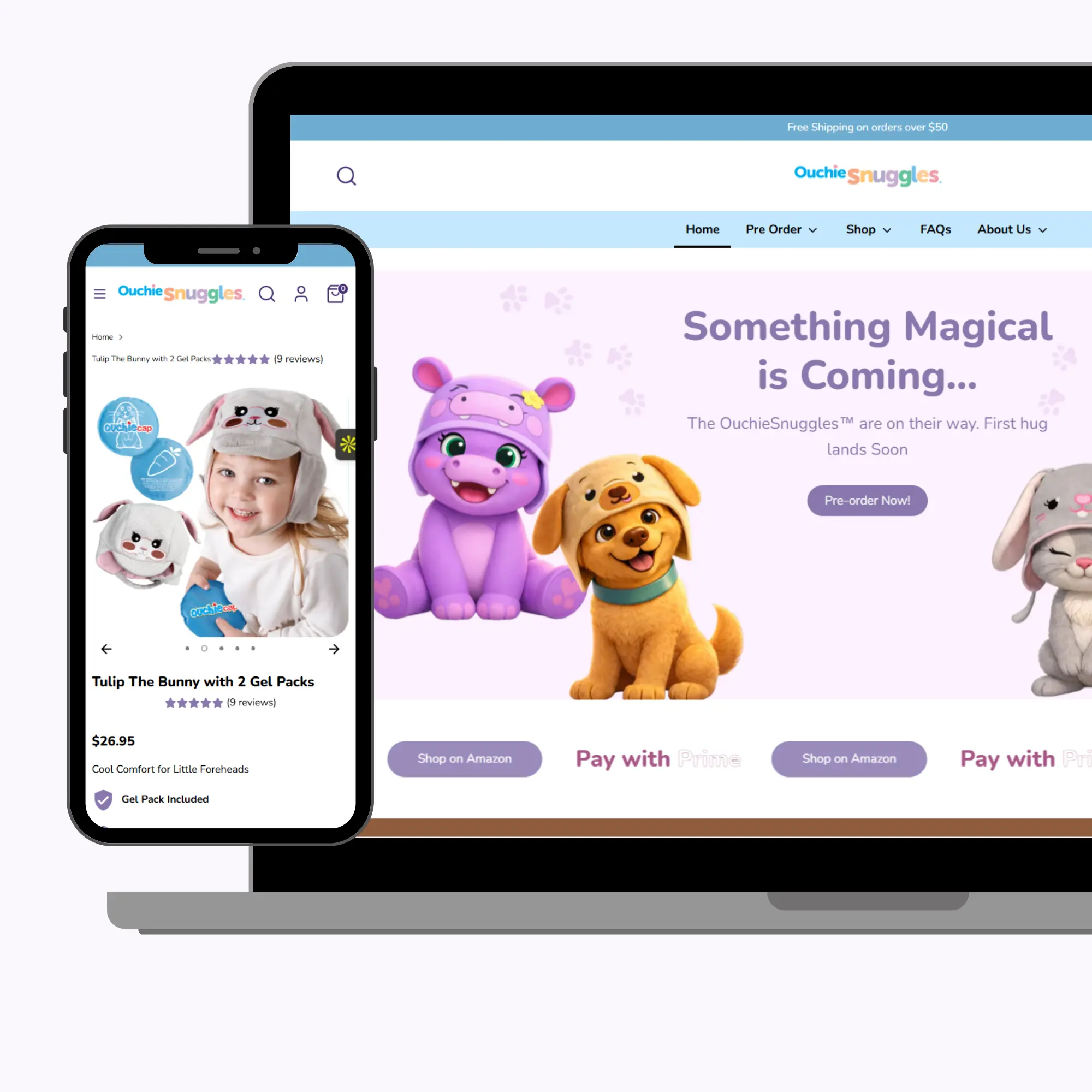
Ouchie Cap sells wearable gel-pack therapy caps for children — a single product line, character-led, previously living on Amazon and Walmart. We built the brand experience, the store and the entire email system. You can go and look at it right now, which is the only kind of proof worth showing.
Ouchie Cap
Four characters — Toby the Puppy, Tulip the Bunny, Kosmo the Bear, Lilly the Hippo — each carrying a different emotional job. That is a brand, and it is the thing an Amazon listing page can never let you build. The store is soft, warm and unmistakably theirs; it does not look like a theme with a logo dropped in, because it isn't one.
We're linking the live store rather than quoting numbers. Their commercial results are theirs to share, not ours — ask us on the call and we'll tell you what we're permitted to.
The part most agencies don't set up
Keep FBA. Keep the Prime badge. Take the customer.
The usual objection to going direct is fulfilment — you've spent years getting FBA to work and Prime delivery is why people buy. Buy with Prime removes that objection entirely, and almost nobody building these stores bothers to configure it.
Prime on your own domain
The Prime badge, the delivery promise and the checkout your buyers already trust — sitting on your store instead of on a listing page you share with three competitors.
FBA keeps fulfilling
Same inventory, same warehouse, same process. Nothing about your operation changes and you don't take on a 3PL to sell direct.
You get the email address
The difference that matters. The order runs through your store, so the customer record, the consent and the ability to sell again are all yours.
Commerce mechanics we build in as standard
These are what turn a brochure into a store that actually sells
- Pre-order — sell before stock lands, capture demand and cash flow, with clear ship-date messaging so nobody is surprised
- Made-to-order — configurable or personalised products with lead-time logic and production-aware inventory
- Buy with Prime — Prime delivery and checkout on your own domain, with FBA continuing to fulfil
- Bundles & kits — the merchandising Amazon won't let you design, priced and presented your way
- Subscriptions — replenishment where the category supports repeat purchase, which is where the real margin lives
- Reviews & UGC — social proof on your product page, owned by you rather than borrowed from a marketplace
The September cohort
Three packages. Half price. One reason.
Every one is designed and built from scratch — no premium theme, no page builder, no template with your logo dropped in. What changes between them is catalogue size and how orders get out of the door.
Launch
One hero product with variants and bundles. The Ouchie Cap shape.
6–8 weeks · 30-day rush +$2,500
- Brand identity system
- Custom UI/UX, designed and built
- Full Klaviyo build
- Pre-order & made-to-order
- Buy with Prime configured
- Bundles & subscription-ready
- Server-side conversion tracking
Catalogue
10 to 100 SKUs across a real range. Collections, filtering, merchandising.
8–10 weeks · 30-day rush +$3,500
- Everything in Launch
- Full catalogue migration & taxonomy
- Collection architecture & faceted filtering
- Search tuned for your range
- Cross-sell & bundle merchandising
- Per-collection Klaviyo segmentation
- Bulk product data tooling for your team
Volume
High order counts, shipped from your own warehouse or supplier network.
10–14 weeks · no rush track
- Everything in Catalogue
- Multi-channel inventory sync — no overselling
- 3PL, WMS or supplier feed integration
- Order routing & fulfilment automation
- Live carrier rates & shipping rules
- Wholesale / B2B pricing tiers
- Returns & exchange workflow
- Built to hold up at peak volume
On the rush track: 30 days is realistic for Launch and tight but achievable for Catalogue. It is not offered on Volume — warehouse and inventory integrations have failure modes you find in week six, and we will not sell you a date we cannot hit. The rush fee buys dedicated senior capacity, and it requires 48-hour feedback from you with scope locked at kickoff.
| Launch | Catalogue | Volume | |
|---|---|---|---|
| Catalogue size | 1 product + variants | 10–100 SKUs | 100+ SKUs |
| Fulfilment | FBA / Buy with Prime | FBA or 3PL | Own warehouse, WMS or supplier network |
| Brand & custom UI/UX | ✓ | ✓ | ✓ |
| Full Klaviyo build | ✓ | ✓ + segmentation | ✓ + segmentation |
| Pre-order & made-to-order | ✓ | ✓ | ✓ |
| Buy with Prime | ✓ | ✓ | Optional |
| Collections & filtering | — | ✓ | ✓ |
| Inventory sync across channels | — | — | ✓ |
| Order routing & carrier rates | — | — | ✓ |
| Wholesale / B2B tiers | — | — | ✓ |
| Timeline | 6–8 weeks | 8–10 weeks | 10–14 weeks |
| Cohort price | from $6,500 | from $9,500 | from $14,500 |
Permission to publish the build as a named case study, a testimonial at launch, and a founder who will take a reference call. Ouchie Cap proved the model on a single-product brand; we want the same evidence at catalogue and at volume. That is the whole trade — no upsell, no mandatory retainer, nothing buried in the contract. When the five slots are filled, prices return to normal.
Five slots across all three packages, not five per package. If the cohort fills with Volume builds we will say so and put you on the October list rather than take on more than we can staff properly.
Prices are starting points against the scope described. Custom photography production, complex made-to-order configurators, and unusually messy product data are quoted separately — still at cohort rates. Final scope and price confirmed in writing before anything begins.
What it looks like
Live before the Q4 peak.
The timing is deliberate. A store live in October has November and December to prove itself — and that is the window where an owned channel pays for itself fastest. Weeks below describe Launch; Catalogue and Volume extend the build phase rather than adding new ones.
Positioning, identity, and who you are outside a search results page. For Ouchie Cap this was the characters. For you it will be something else.
Home, product, collection, cart and content templates designed in full and signed off before anyone writes code.
Custom theme built to the design. Catalogue, pre-order, Buy with Prime, Klaviyo and tracking configured. On Volume this is where inventory and fulfilment integration lands.
Performance verified on production, tracking confirmed firing, flows live. You go into Q4 with a channel you own.
- What it is
- A complete brand and Shopify store build for Amazon sellers going direct — identity, custom UI/UX, full Klaviyo build, pre-order and made-to-order, Buy with Prime, and conversion tracking. Three packages by catalogue size and fulfilment model.
- Who it's for
- Amazon brands doing $10,000+ per month who own their Brand Registry and want a professional store rather than a template — from single-product sellers to high-volume operations shipping from their own warehouse.
- Packages
- Launch — one product + variants, from $6,500. Catalogue — 10 to 100 SKUs, from $9,500. Volume — own-warehouse fulfilment and multi-channel inventory, from $14,500.
- Cohort size
- Five brands total, across all three packages. Applications close Friday 28 August 2026; the cohort begins the first week of September.
- Discount
- 50% off every package, in exchange for case study rights and a testimonial. Milestone billing.
- Timeline
- 6–8 weeks for Launch, 8–10 for Catalogue, 10–14 for Volume. A 30-day rush track is available on the first two only.
- Premium theme needed?
- No. Every package is designed and built from scratch. You never buy a theme licence, and the store does not look like everyone else's.
- Proof
- Ouchie Cap — an Amazon brand taken direct with brand design, a custom store, a full Klaviyo build, pre-order and Buy with Prime. Live at ouchiecap.com.
Qualification
Five slots means saying no a lot.
We would rather you self-select out in thirty seconds than discover it on a call next week. The right-hand column is not false modesty — those are genuinely bad fits and we will say so in the reply.
Apply if
Any one of the three packages could be yours
- You do $10,000+ per month on Amazon and it has been steady for six months or more
- You own the brand — registered trademark, Brand Registry, your own products
- You sell one product, a range of ten to a hundred, or high volume from your own warehouse
- You have no real website, or something built once on a template and abandoned
- You want it to look properly designed, not like a theme everyone else is running
- You accept that traffic is now your job, and you have some budget for it
Don't apply if
We will decline these, politely and quickly
- You resell other people's branded products — retail or online arbitrage, wholesale flips
- You're under $10,000 a month. Fix product-market fit first; a store won't do it for you
- You want a $500 template setup. Fair goal, wrong agency, and we'll name a better route
- You want Volume delivered in 30 days. Warehouse integration doesn't compress and we won't pretend it does
- You expect the store to generate its own traffic. It won't. Nothing does
- You want us to replace Amazon. That's a bad plan and we'd talk you out of it
Questions we get
Straight answers.
What's the catch with 50% off?
Case study rights, a testimonial at launch, and a founder who will take a reference call. That's it — no mandatory retainer, no upsell, no clause buried in the contract. Ouchie Cap proved the model; five more documented builds turn it into a category we're known for, and that is worth more to us than the margin on five projects. When the five are filled, every package returns to its normal price — which is what this work costs to do properly.
Do I have to leave Amazon?
No, and we would argue against it. Amazon is a demand channel that works — keep it running exactly as it is. What changes is that it stops being the only thing you have. Most brands find the Amazon business gets more profitable afterwards, because they stop spending their entire budget defending a listing page and start building an audience they can reach for free.
Where does traffic come from? I've never run my own.
Honestly: at first, from you. Paid social, your existing buyers where you can reach them, organic search over a longer horizon, and whatever audience your category has on the platforms Amazon doesn't own. The store makes that traffic convert and compound — it does not create it. Anyone telling you a new site generates its own demand is selling you something. We set up tracking properly so your first dollar of spend is measurable, and we will tell you plainly if we think your category is a hard one to buy traffic in.
I don't have brand assets or proper photography. Is that a problem?
It's the normal starting point and it's why brand identity is week one rather than an afterthought. Amazon-compliant imagery — white background, six angles, infographics — almost never carries a brand, so we art-direct a shot list, reformat what's usable, and identify the gaps. Ouchie Cap needed character illustration built from scratch; yours may need something else entirely. Full photography production is quoted separately if you need it, still at cohort rates.
How long, and what do you need from me?
Six to eight weeks standard, or 30 days on the rush track for an additional $2,500. From you: a few hours a week from someone who can actually decide, your product data and imagery, and timely feedback at design sign-off. On the rush track that becomes 48-hour turnarounds and a scope locked at kickoff — the compressed schedule has no slack in it, so a slow week from either side moves the date.
What happens after launch?
Nothing you're obliged to buy. You own the Shopify account, the code, the brand files and the data, and the handover is written so your team or another agency can pick it up. If you'd rather we kept going, our retainers cover ongoing work — but the build stands on its own and there is no requirement attached to the cohort price.
What if all five slots go?
Apply anyway. We keep a waitlist for the October cohort and tell you where you sit on it. We would rather run five properly than eight badly — the constraint is senior engineering time, not appetite, and stretching it is how agencies end up delivering the thing you were worried about in the first place.
Next step
Own the customer you already paid for.
Five slots, September 2026, applications close Friday 28 August. A senior engineer reads every application and replies within one business day — including the declines, with the reason.