Strategy & growth · The CRO retainer
Shopify growth marketing agency in the USA: CRO, SEO and analytics run as one programme.
Most brands buy conversion optimisation, SEO and analytics from three vendors and wonder why nothing compounds. On this retainer one senior team runs all three against a single roadmap: the analytics decide what to test, the tests decide what gets built, and search compounds whatever converts.

 5.0 on Shopify Partners · Premier Verified on Clutch
At a glance
What you are buying, in one screen.
The retainer hub covers all six programmes; this page is the one most brands start with.
The growth retainer, in plain terms.
Everything below is answered in detail further down the page.
- What it is
- An ongoing, month-by-month programme for Shopify and Shopify Plus stores that puts conversion rate optimisation, technical SEO and analytics under one senior team and one roadmap — instead of a one-off audit, a redesign, or three agencies with three decks.
- Who it’s for
- Brands doing $500K+ a year with a known bottleneck in conversion rate, organic growth or attribution. Testing needs roughly 25,000 sessions and 300+ monthly conversions on the template in question; below that we lead with research and SEO, and we say so.
- What runs monthly
- Two to four powered experiments live at a time, a ranked hypothesis backlog, a technical SEO sprint (Core Web Vitals, schema, crawl health, internal links, content clusters), event and dashboard QA, and one written readout that covers all three.
- How we call a result
- Sample size, minimum detectable effect and stopping rule are declared before a test starts, then honoured. No peeking, and no calling a winner because the line looks good on day three.
- Who does the work
- A named senior Shopify engineer leads the retainer; the variants and fixes are built by the same engineers who build our client storefronts. No rotating pool, no account manager relaying messages.
- Investment
- Growth tier from $6,000 a month — two disciplines, always one experiment running. CRO & experimentation on its own from $4,000 a month. Three-month initial term, then rolling monthly with 30 days’ notice.
- What it is not
- Not a redesign, not a guaranteed uplift, and not a report that only shows the winners. Anyone quoting a conversion lift before seeing your data is selling a number, not a programme.
Why one programme
Three vendors compete. One programme compounds.
The failure mode is rarely bad work. It is three good teams optimising three different numbers on the same store.
Three agencies, three decks
Plausible, busy, impossible to learn from
- The CRO agency ships a redesign that drops the headings and internal links the SEO agency spent a quarter earning
- SEO content ranks, then converts at a third of the site average because nobody tested the template it lands on
- Analytics was set up by whoever installed the last pixel — three dashboards, three definitions of a conversion
- Every vendor reports against its own metric, so the month always looks good somewhere
- Nobody owns the trade-off when speed, tracking scripts and a new app collide
- You are the project manager, and you are paying three retainers
One roadmap, one readout
Slower to promise, easier to hold to account
- One backlog, ranked by expected revenue across CRO, SEO and analytics
- Every test runs on a template whose search value is known, so a win never costs a ranking
- One event schema across GA4 and Shopify, so a conversion means the same thing in every report
- Losers are written up — a disproven assumption changes the next SEO brief as well as the next test
- A performance budget enforced across theme, apps and tags; speed is a shared constraint, not a department
- One senior contact, one monthly call, one number you are trying to move
What runs monthly
Six things that happen every month, whether or not anyone chases them.
Scope is agreed at the start of the month and reported at the end of it. The weight between the three moves as the data says.
- 01
Research and analytics
GA4 and Shopify analytics audited and kept honest: event QA, funnel and segment reviews, session recordings on the pages that carry the money, and dashboards that answer one question each.
- 02
Experimentation
Two to four A/B tests live at a time — each single-variable, powered from your real baseline, run concurrently with its control and stopped by a rule that was written down before launch.
- 03
Technical SEO
Core Web Vitals on field data, structured data, crawl health, redirects and canonicals, internal linking and content clusters — planned around what already converts, so search sends people to pages that work.
- 04
Build and QA
Variants and fixes built in your theme by senior Shopify engineers: no flicker, no layout shift, no render-blocking test script, and tested on real phones before anything goes live.
- 05
Readout and decision
One monthly document across all three disciplines — what ran, what it moved, what it taught us and what runs next — followed by one call to set next month’s weight between them. Losers included.
- 06
Compounding
Winners become the new default and are documented; what they teach reshapes the SEO brief and the next backlog. The programme builds on itself instead of resetting every month.
How a month runs
From the first call to the quarterly review.
The first two weeks are diagnosis. Everything after that is the loop.
Discovery call
Before anything is signed: the current state across CRO, SEO and analytics, what the store can actually test at its traffic, and what “good” would look like in ninety days.
Audit · weeks 1–2
Tracking and analytics audit, a CRO teardown of the templates that carry your traffic, and a technical SEO crawl. One prioritised list comes out of it, not three.
The 90-day roadmap · week 2
Hypotheses, SEO fixes and tracking work sequenced by expected value and dependency, with a performance budget everyone signs before the first build.
The monthly loop · week 3 onward
Build, launch, run to the rule, ship or kill — with the SEO sprint running alongside. Nothing goes live that has not been tested on a phone.
Monthly readout
One document and one call: what ran, what it moved, what it taught us, and how the weight shifts between the three next month.
Quarterly review
The roadmap re-planned against the numbers, scope re-weighted, and the term rolls monthly from here — with 30 days’ notice either way.
Where the money usually is
What we test first, ranked by how often it wins.
Ranked roughly by how often the test wins on the stores we see. Button colour is not on the list.
- 01
Product page architecture
What appears above the fold, where price and shipping sit, how variants are chosen, and where trust content interrupts hesitation.
- 02
Cart and checkout path
Drawer versus page, the moment shipping cost is revealed, express payment prominence, and how many decisions sit between intent and payment.
- 03
Collection and discovery
Filtering, sort defaults, how many products load before fatigue, and whether the grid answers the question the visitor arrived with.
- 04
Merchandising and offer
Bundle framing, threshold messaging for free shipping, cross-sell placement and whether urgency helps or costs you trust.
- 05
Copy and value proposition
Headline framing, benefit ordering, and how the brand answers the objection a visitor already had before arriving.
- 06
Mobile interaction cost
Tap targets, sticky elements competing for the same space, and the interaction delay that makes a phone feel broken rather than slow.
Honest statistics
What has to be true before we call anything a win.
These are the checks we apply before a result reaches your readout. Most CRO reports you have been sent would fail at least two.
| Check | What it means | What happens if it is skipped |
|---|---|---|
| Powered | Sample size calculated from your baseline and the minimum effect worth detecting. | The test cannot see the effect it claims to have found. Most “wins” are noise. |
| Concurrent | Control and variant run at the same time, to the same traffic mix. | You are comparing March to April and calling the weather a conversion lift. |
| Pre-declared | Stopping rule and success metric agreed before launch. | Peeking until it looks good manufactures a false positive roughly one time in three. |
| Single-variable | One change per variant. | Something moved. Nobody can say what, so nothing is learned for next time. |
| Segment-checked | The result holds on mobile and desktop, new and returning. | A desktop win hides a mobile loss, and you ship a net negative. |
| Durable | Re-checked after ship for novelty decay. | The uplift evaporates in six weeks and nobody notices it left. |
Pricing
Priced on the programme, not on hours.
Hourly billing rewards slow work. These are priced on scope and response time, so the incentive is to fix things properly the first time.
CRO & experimentation
Testing only. For stores with the traffic to test and a theme that is already sound.
$4,000 / mo
from · 3-month term
- Hypothesis backlog ranked by expected value
- Two to four live experiments at a time
- Variant build and QA by senior engineers
- Statistical readout of every result, losers included
- Monthly decision call
Most common
Growth
CRO plus technical SEO or analytics — the programme this page describes.
$6,000 / mo
from · 3-month term
- Everything in CRO & experimentation
- A second discipline: technical SEO or analytics
- Always one experiment running
- Performance budget enforced across theme, apps and tags
- Same-business-day response
- Monthly strategy call
Partner
All six retainers. For brands without an ecommerce engineering team of their own.
$12,000 / mo
from · 3-month term
- Everything in Growth
- Support, lifecycle, performance and development hours in scope
- Dedicated senior engineer
- Priority response with an SLA
- Roadmap planning and quarterly review
- Direct Slack channel
Proof
Real stores. Verified numbers.
Every number here is verified with the brand it belongs to — and both builds below started with the tracking, not the design.
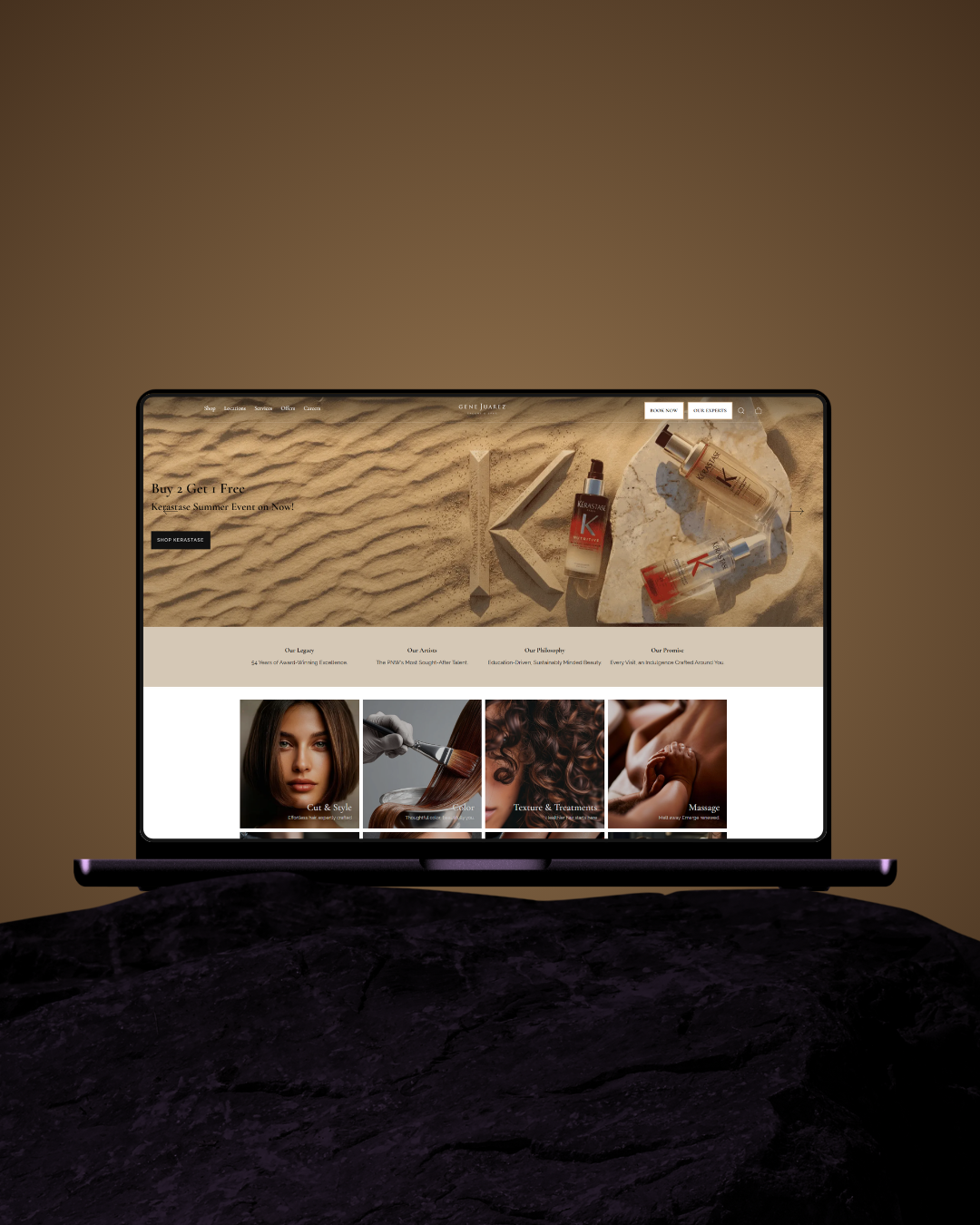
Service commerce · Shopify Plus
Gene Juarez: tracking audit and remediation before a single test ran.
- GTM, GA4, Meta CAPI, Google Ads
- Booking + retail on one store
- Zenoti integration
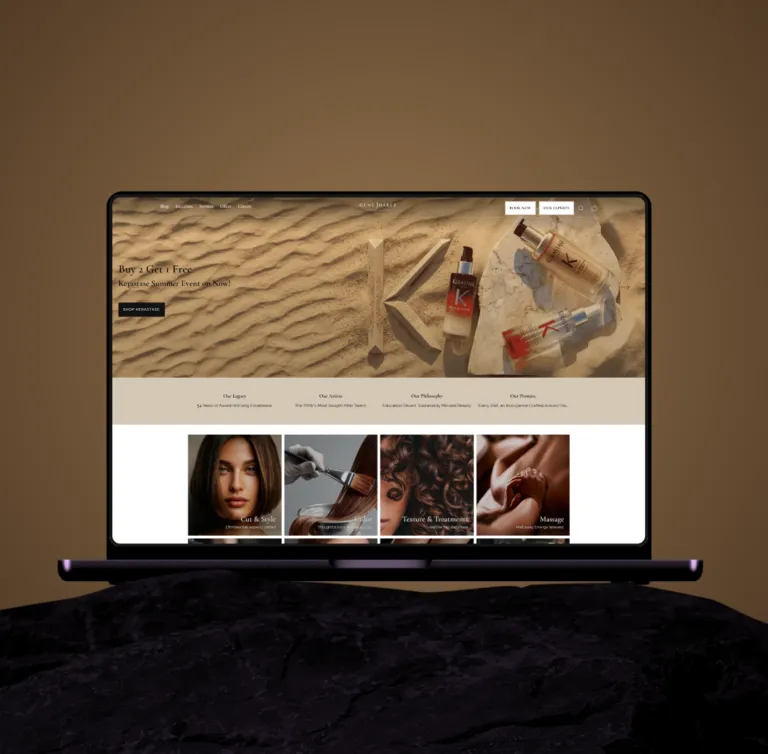
The Pacific Northwest’s largest salon group had three tools counting the same booking three different ways. We rebuilt the event schema across GTM, GA4, Meta Pixel/CAPI and Google Ads first — then unified salon booking and retail on Shopify Plus, the integration most agencies declined.

DTC · Figma to Shopify
getKif: a theme built to be tested, not just launched.
- Ground-up custom build
- Performance engineered
- Editable end to end
A fully custom Shopify theme built from Figma with no Dawn reskin and no app bloat — every section editable from the Theme Customizer, which is what makes a testing programme cheap to run on it afterwards.
Straight answers.
Why not run CRO, SEO and analytics as separate agencies?
Because they compete the moment nobody coordinates them. A CRO redesign can drop the headings and internal links SEO spent a quarter earning; SEO content lands on templates nobody tested; analytics set up by three vendors gives you three definitions of a conversion. One roadmap and one readout remove the trade-offs nobody was owning.
Can I hire you for just one of the three?
Yes. CRO & experimentation runs on its own from $4,000 a month, and SEO & GEO and analytics work are available as their own retainers. The Growth tier exists because the return is meaningfully higher when at least two run together against one backlog.
How much traffic do I need?
Roughly 25,000 monthly sessions and 300+ conversions on the template you want to test. Below that a test takes months to reach significance and the business changes underneath it, so we lead with research, tracking and technical SEO and tell you when testing becomes worth the money.
Do you guarantee a conversion uplift?
No. What we commit to is a defined number of properly powered experiments a month, honest readouts that include the losers, and the SEO and analytics scope delivered as agreed. Anyone quoting an uplift before seeing your data is selling a number rather than a programme.
What if I already have an SEO agency?
We coordinate with them. Plenty of our CRO clients keep an SEO partner they are happy with; the roadmap and the monthly readout still cover all three so that nothing is optimised in isolation, and we take the SEO seat ourselves only if you ask.
Who actually does the work?
A named senior Shopify engineer leads the retainer, and the variants are built by the same engineers who build our client storefronts. That matters more than it sounds: badly built variants add flicker and layout shift that suppress the very metric you are measuring.
What is the commitment?
Three months, then rolling monthly with 30 days’ notice. Three months because almost nothing meaningful — a powered test, a Core Web Vitals change showing in field data, a ranking shift — resolves inside one.
How is this different from the CRO service or the free audit?
The free CRO audit and the fixed-scope CRO service are one-off pieces of work: a diagnosis and a set of prioritised fixes. This retainer is the ongoing programme that runs afterwards — or instead of it, when your templates are already sound and the job is to keep moving the number.
Start a project
Got a project in your mind?
Tell us what the store needs to do. A senior engineer replies with a scoped answer, not a sales deck.


Shopify Plus experts
Let's talk Shopify, Shopify Plus and the store you actually want.
An accredited Shopify Plus agency that designs, builds, migrates, supports and grows stores for brands that have outgrown templates. Ready when you are: talk to an engineer about the project.
Get in touch