
Shopify vs Magento (Adobe Commerce) is a major decision for any ecommerce business choosing between a managed platform and a highly customizable commerce solution. Shopify offers easier day to day management, predictable infrastructure, and faster implementation, while Magento and its commercial edition, Adobe Commerce, offer deeper customization and enterprise level B2B capabilities. This guide compares both platforms across pricing, SEO, scalability, customization, B2B, security, performance, and total cost of ownership so you can choose the right one for your business in 2026
Shopify vs Magento
Shopify is generally the better choice if you are a small to mid sized business, a DTC brand, or a lean team that wants a hosted platform with predictable costs and fast time to launch. Magento, now sold commercially as Adobe Commerce, tends to make more sense for large enterprises with complex B2B requirements, deep ERP integrations, or highly customized catalog logic that a hosted platform cannot easily accommodate.
There is no universal winner here. A ten person DTC brand and a $50 million B2B distributor are answering completely different questions when they type “Shopify vs Magento” into Google, and the right platform depends on which one you actually are.
Shopify vs Magento at a Glance
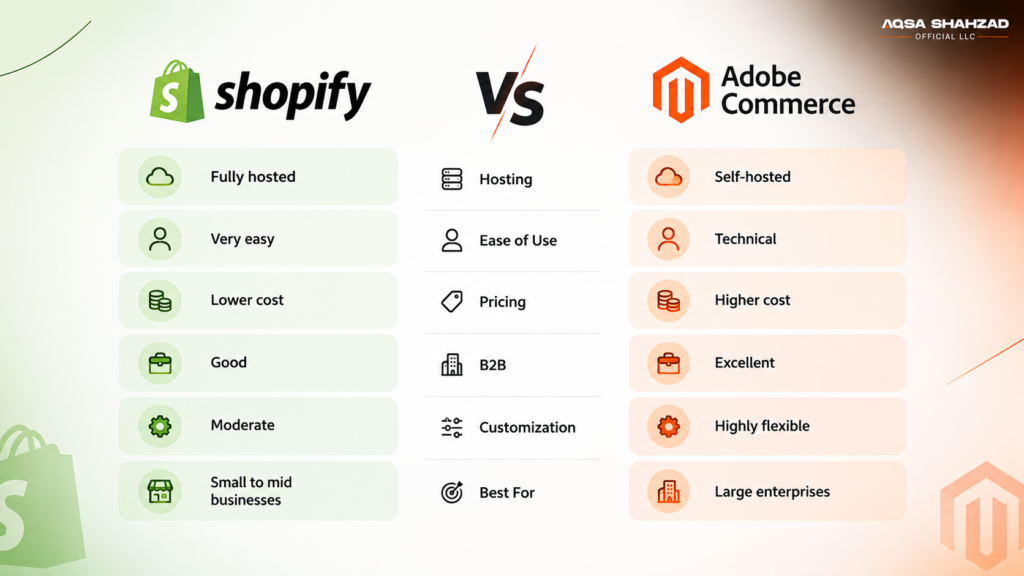
| Factor | Shopify | Magento (Open Source / Adobe Commerce) |
|---|---|---|
| Hosting | Fully hosted SaaS | Self-hosted (Open Source) or Adobe managed cloud (Adobe Commerce) |
| Ease of use | Low learning curve, admin friendly | Steeper learning curve, developer dependent |
| Pricing | $39 to $399/month on core plans, Plus from $2,300/month | Open Source is free to license; Adobe Commerce is quote based, typically starting around $22,000/year |
| SEO | Strong automated basics, less low level control | Deep technical control, requires more setup |
| B2B features | Native on all paid plans as of 2026 | Native enterprise grade B2B on Adobe Commerce |
| Customization | Themes and apps, checkout customization on Plus | Full code level control, open architecture |
| AI and automation | Shopify Magic and Sidekick built in | Adobe Sensei based AI suite on Adobe Commerce |
| Security | Automatic updates, PCI compliance included | Self-managed on Open Source, managed on Adobe Commerce |
| Best for | Small to mid sized businesses, DTC brands, lean teams | Complex B2B, large catalogs, enterprises with dev resources |
Treat this table as a starting point rather than the final word. Implementation quality, your team’s technical capacity, and how each platform is actually configured will affect these outcomes more than the platform choice alone.
What Is Shopify?
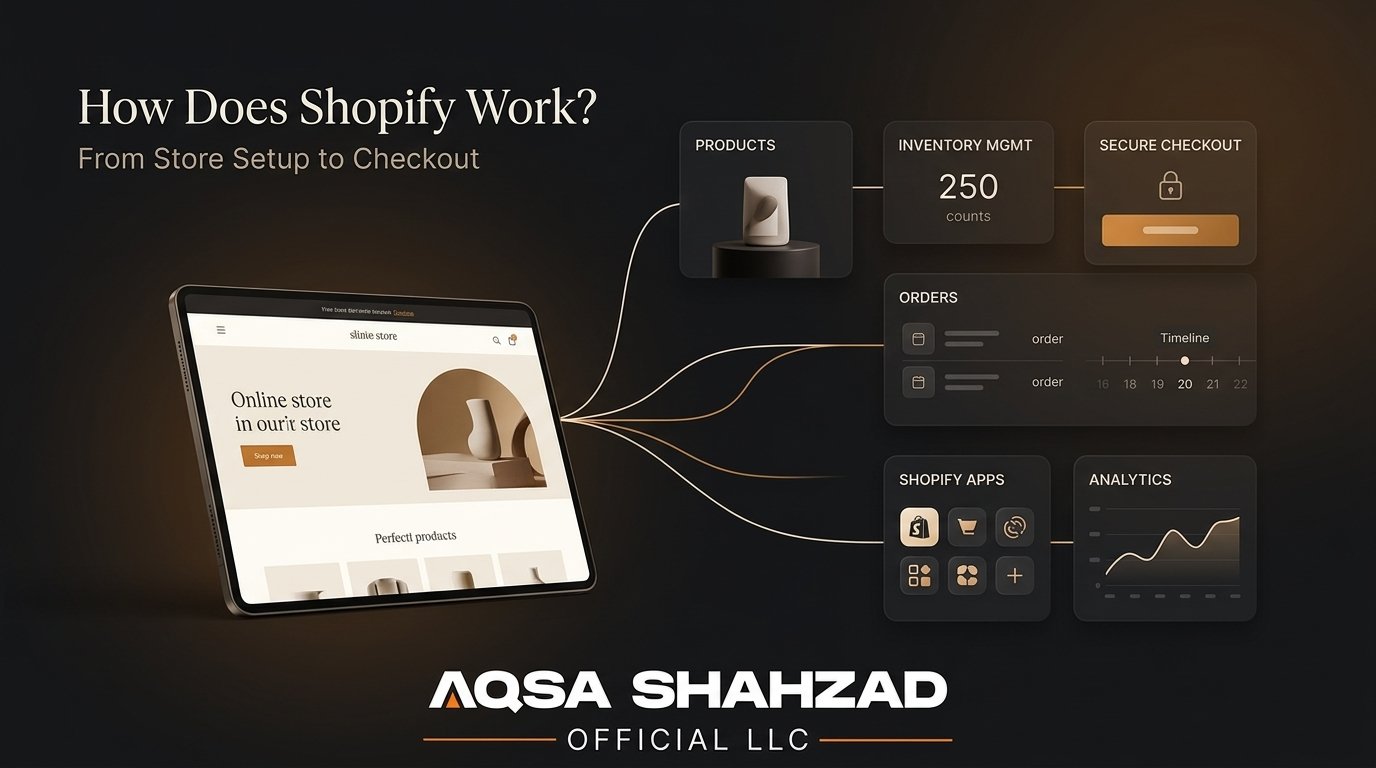
Shopify is a fully hosted, cloud based commerce platform. You do not manage servers, apply security patches, or configure caching layers. Everything from checkout to hosting to app installation happens inside one admin panel, and Shopify handles the infrastructure behind it.
What Is Magento (Adobe Commerce)?
Magento is more complicated than a single product name suggests, and this distinction matters throughout the rest of this comparison. Magento Open Source is the free, self-hosted version of the platform. You can download it at no license cost, but you are responsible for hosting, security patching, and every piece of infrastructure that keeps the store running. Adobe Commerce is the commercial, enterprise edition of the same platform, sold with additional B2B features, AI tools through Adobe Sensei, and either on premise or Adobe managed cloud hosting.
Many comparisons treat “Magento” as one product, which leads to confused conclusions about pricing, support, and who the platform is actually for. Open Source and Adobe Commerce answer to very different budgets and business sizes, and it is worth knowing which one you are actually comparing against Shopify before you go further.
Ease of Use and Who Should Manage the Store
Shopify was built so a non-technical team member could set up products, configure shipping zones, and launch a store without writing code. The admin interface is drag and drop for most day to day tasks, and content changes, discount codes, and basic layout adjustments do not require developer involvement.
Magento assumes a developer is in the loop. Setting up complex product types, configuring layered navigation, or making structural changes typically requires PHP knowledge and command line access, even on Adobe Commerce’s more polished admin. This is not a flaw so much as a tradeoff: the same openness that makes Magento harder to use is what gives it deeper customization potential later in this article.
If your team does not have a developer on staff or on retainer, this single factor often decides the comparison before pricing or SEO even enter the conversation.
Pricing and Total Cost of Ownership
Subscription price alone is a misleading way to compare these platforms. What matters is total cost of ownership, meaning the subscription or license plus hosting, development, apps, and ongoing maintenance.
Shopify’s core plans as of 2026 are Basic at $39 per month, Grow at $105 per month, and Advanced at $399 per month, each with a meaningful discount for annual billing. Shopify Plus, the enterprise tier, starts at $2,300 per month on a three year term or $2,500 per month on a one year term, transitioning to a variable fee based on gross merchandise volume once monthly sales cross roughly $1 million. Transaction fees apply if you do not use Shopify Payments, decreasing as you move up plan tiers. On top of the subscription, budget for apps, theme customization, and development time for anything beyond what the built in tools cover.
Magento Open Source has no license fee, but running it is not free. Expect to pay for hosting, ongoing development, security patching, and extensions, with realistic annual costs ranging from a few thousand dollars for a very small store to well over $50,000 for a serious mid sized one. Adobe Commerce does not publish pricing publicly. Based on consistent third party estimates from implementation partners, on premise licensing typically starts around $22,000 per year and can reach $125,000 or more depending on your gross merchandise value, with Adobe Commerce Cloud running higher once hosting is included. Adobe recommends contacting their sales team directly for an accurate quote, since pricing is tied to your specific revenue and requirements.
The honest summary: Shopify’s subscription is more predictable, but development, apps, and Plus level customization can still add up. Magento’s license may be free or negotiated, but hosting, security, and developer time are the real ongoing cost, and they do not shrink as your store grows.
Shopify vs Magento for Small Business
For a small business or an early stage DTC brand, Shopify is generally the more sensible choice. There is no infrastructure to manage, no developer required for day to day changes, and the subscription pricing is predictable from month one. A small team can launch a fully functioning store, publish content, and start selling within weeks rather than months.
Magento, including Open Source, is rarely the right fit at this stage. Even without a license fee, the hosting, security, and development time required to keep a Magento store running properly tends to outweigh what a small catalog and lean team actually need. Businesses in this bracket are typically paying for flexibility they will not use for years, if ever.
Shopify vs Magento for Enterprise
At the enterprise end, the decision gets more genuinely contested. Shopify Plus has closed much of the gap that used to make Magento the automatic enterprise choice, with native B2B features, checkout extensibility through Shopify Functions, expansion stores for international operations, and automatic scaling for high volume traffic events. For a mid market growth brand moving into this territory, a Shopify Plus development partner is usually the right next step, since Plus level features require more technical setup to configure well.
Adobe Commerce still holds an edge for the most complex enterprise cases: multi-level company hierarchies, deep ERP integrations across multiple systems, and highly customized catalog or pricing logic that does not fit a hosted platform’s data model. If your enterprise requirements genuinely sit in that territory, and you have the development resources to support it long term, Adobe Commerce remains a legitimate option.
Shopify vs Magento: SEO
Both platforms can rank well in Google. The platform is rarely the reason a store fails to rank; content quality, site architecture, backlinks, and technical execution matter more than which system generated the HTML.
Shopify SEO vs Magento SEO
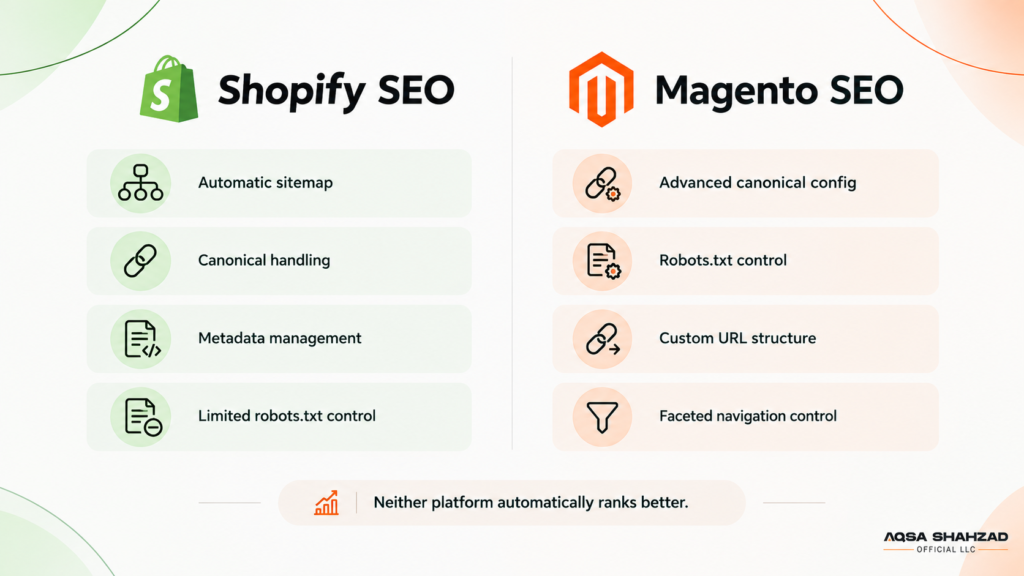
Shopify handles most SEO fundamentals automatically: an automatic XML sitemap, sensible canonical handling, mobile friendly infrastructure by default, fast baseline hosting, and straightforward metadata management through the admin. Its main limitation is low level control. Shopify does not allow full custom control over robots.txt without a workaround, and some URL structures, like the /products/ or /collections/ prefix, cannot be fully removed.
Magento offers greater technical SEO control across the board: advanced canonical configuration, direct robots.txt control, fully customizable URL structures, and more granular faceted navigation management for large catalogs. That control comes at a cost. Getting it right requires stronger technical implementation, and getting it wrong, particularly on faceted navigation, can create thousands of thin or duplicate URLs.
Which is better for SEO? Neither platform automatically ranks better. Shopify is easier to optimize correctly for most small to mid sized businesses, while Magento provides more technical headroom for large, complex catalogs that need precise control over URL structure and indexation.
Shopify vs Magento: B2B Commerce
This is one of the fastest moving parts of the comparison, and a lot of older content still gets it wrong. As of 2026, Shopify includes native B2B features, including company accounts, custom catalogs, custom pricing, and payment terms, on all paid plans, not just Shopify Plus. Feature depth still increases at higher tiers, and Shopify Plus adds unlimited B2B catalogs and more advanced buyer role management.
Adobe Commerce remains the more established enterprise B2B platform, with multi-level company hierarchies, negotiable quotes with approval workflows, requisition lists, and deep ERP integration support that has been refined over many years of enterprise deployments. For a distributor or manufacturer with genuinely complex B2B workflows, multiple ERP instances, or highly specific approval chains, Adobe Commerce’s native depth is still hard to match.
If your B2B needs are more straightforward, meaning company accounts, net payment terms, and custom pricing without deep ERP complexity, Shopify’s native B2B tools are now a realistic option that would not have been true a few years ago.
Performance, Scalability, and Security
Performance on both platforms depends heavily on implementation. Shopify’s hosted infrastructure handles traffic spikes and scaling automatically, which matters most during high volume events. Magento’s performance depends on your hosting setup, caching configuration, and frontend stack, meaning a well optimized Magento store on modern infrastructure can perform very well, while a poorly configured one will struggle under load.
Security works differently on each platform. Shopify includes automatic security updates and built in PCI compliance across all plans, so you are not personally responsible for patching. Magento Open Source puts that responsibility on you or your hosting partner, including manual security patches and SSL setup. Adobe Commerce Cloud shifts more of this responsibility back to Adobe, with more automated patching, though on premise deployments still require your own security management.
If your team does not have dedicated infrastructure or security expertise, Shopify’s managed approach removes a real ongoing burden. If you have that expertise in house, Magento’s flexibility lets you tune performance and security to your exact requirements.
Shopify vs Magento: Customization
Magento’s open source architecture allows customization at nearly every level, from checkout flow to backend data structure to custom order logic. This is a genuine strength for businesses whose operations do not fit a standard ecommerce data model.
Shopify customizes primarily through themes and apps, with deeper checkout customization available on Shopify Plus through Shopify Functions, which replaced the older Shopify Scripts. This covers the large majority of storefront customization needs without touching core code, though it does not match Magento’s ability to alter the underlying data model itself.
The tradeoff is real in both directions. More flexibility on Magento means more development and maintenance responsibility over time. Shopify’s more contained customization model means less flexibility at the edges, but significantly less ongoing technical overhead, and most storefront level customization, from a fully custom Figma design to unique layout logic, can still be handled through custom Shopify theme development without touching the underlying platform.
Shopify vs Magento: AI and Automation
Both platforms have added meaningful AI capabilities, and this is worth evaluating on its own rather than folding into “features” generally.
Shopify includes Shopify Magic, available free across all plans, covering AI generated product descriptions, image editing, and email copy. Shopify Plus adds Sidekick, an AI assistant that can perform admin tasks through natural language, including setting up automations and analyzing sales data.
Adobe Commerce offers an AI suite built on Adobe Sensei, including AI powered product recommendations, Live Search with intelligent re-ranking, and generative content tools, integrated with the broader Adobe Experience Cloud ecosystem.
Neither platform’s AI tooling should be the deciding factor on its own, but if AI assisted store management or AI powered search is a priority, both platforms now offer credible native options rather than requiring third party extensions for basic functionality.
Conversion Rate and Checkout Experience
This is one of the most overlooked parts of the Shopify vs Magento decision, and it deserves more attention than most comparisons give it. Platform choice genuinely affects checkout experience and, by extension, conversion rate. Shopify’s checkout is consistently ranked among the best converting in ecommerce, and Shopify Plus adds checkout extensibility and Shopify Functions for custom discount, shipping, and payment logic without forking core code. Magento’s checkout is fully open to customization, which can be an advantage for very specific workflows, but it also means checkout performance and conversion depend entirely on how well it has been built and maintained.
Site speed plays into this directly. A slow product page or a clunky checkout step costs you sales regardless of which platform generated it, but the platforms differ in how much work it takes to get to a genuinely fast, high converting storefront. This is also where the comparison becomes more than theoretical: a platform migration or a Plus level rebuild is often the right moment to fix conversion issues that have been quietly costing revenue for years. If you’re evaluating a move to Shopify Plus and want to know what a proper conversion rate optimization program looks like on top of it, that is worth scoping alongside the migration itself, not as an afterthought once the new store is already live.
Content Management and Marketing Team Usability
Most Shopify vs Magento comparisons are written for a technical decision maker evaluating architecture. Fewer address the person who will actually log in every day to publish a blog post, update a product description, or launch a landing page, and this gap is worth closing.
Shopify’s content tools are built for non-technical use. A marketer can publish blog content, edit product pages, and build simple landing pages from the admin without developer involvement, though Shopify’s native blog and page builder are intentionally simple and are not designed for content heavy sites with complex layouts.
Magento’s content management system is more powerful on paper, with a proper page builder and support for more complex content types, but using it well still generally requires more technical comfort than Shopify’s admin does. For a content and SEO focused team publishing regularly, that difference in daily usability is not a minor detail. It is the difference between shipping content the same day and waiting on a developer’s availability.
Apps, Extensions, and Ecosystem
Both platforms rely heavily on third party extensions to fill functionality gaps, and the size of the ecosystem matters less than how well a given app or extension is maintained and how much ongoing dependency it creates.
Shopify’s App Store is large and tightly moderated, and most apps install and configure without developer involvement, which keeps ongoing maintenance relatively low. Magento’s extension marketplace is also extensive, but extensions are typically installed and updated through the command line, and compatibility between extensions and Magento core updates is a genuine, recurring maintenance concern.
The practical question is not “which platform has more apps,” but how much ongoing developer time a given app or extension will require to keep working as the platform updates. Shopify tends to be lighter here for most standard use cases; Magento’s deeper extensibility comes with a proportionally higher maintenance load.
Migrating Between Platforms
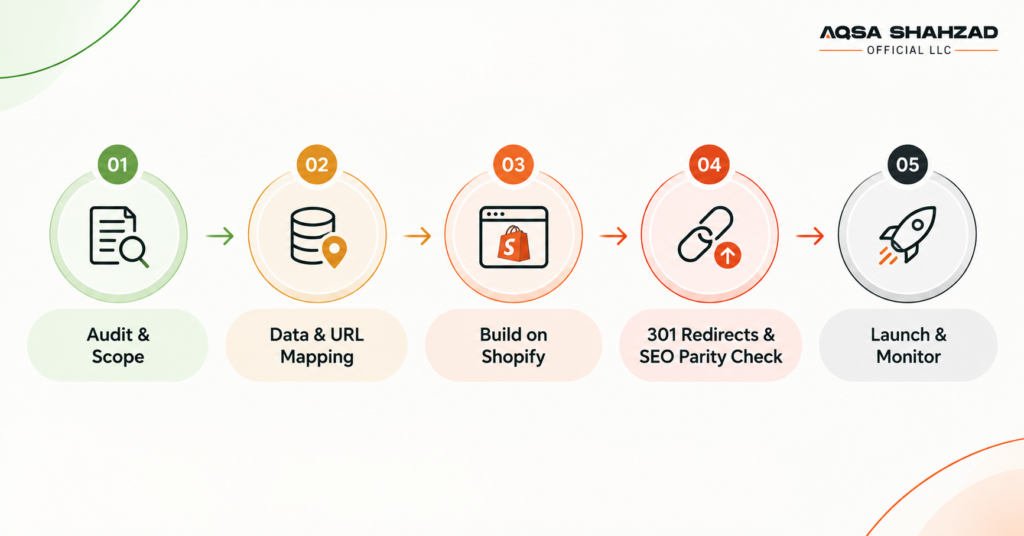
A meaningful share of people comparing Shopify and Magento are not starting from scratch. They are already running a store and evaluating whether to switch.
Migrating from Magento to Shopify typically makes sense when the ongoing cost of hosting, security, and developer maintenance has outpaced the value of Magento’s customization, or when a growing catalog and traffic base would benefit from Shopify’s managed infrastructure and lower technical overhead. This is currently the more common direction of migration among mid sized and growing brands.
Migrating from Shopify to Magento is far less common, and tends to happen when a business has genuinely outgrown Shopify’s data model, most often around highly complex B2B workflows, multi-entity operations, or deep ERP requirements that Shopify’s structure cannot accommodate even on Plus.
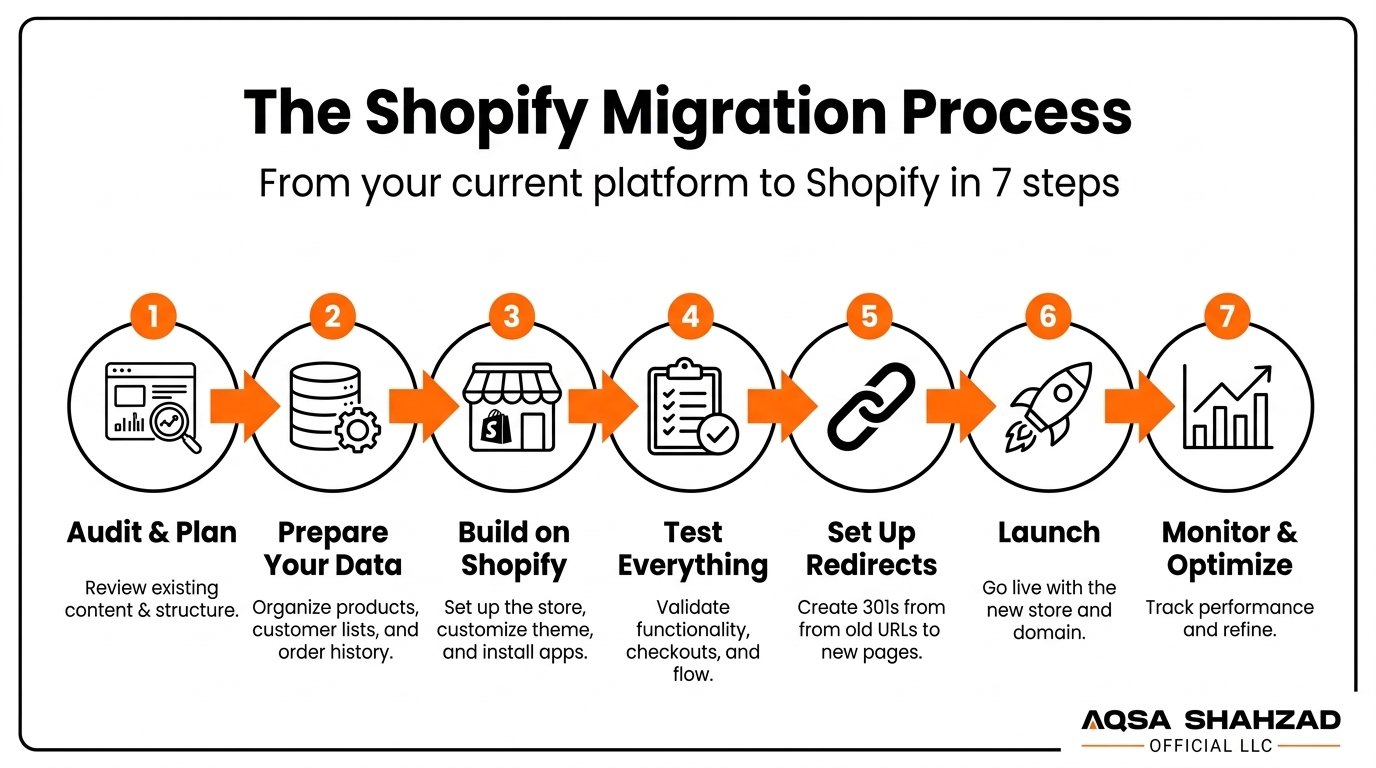
Either direction, migration is not simply a design rebuild. It involves moving products, customers, and order history, mapping and redirecting every existing URL to preserve SEO equity, migrating content and integrations, and running a genuine testing period before cutover to avoid downtime or lost revenue. Treat any migration timeline that skips SEO redirect mapping or a pre-launch parity audit as a red flag, regardless of which agency is proposing it. If you are currently on Magento and evaluating this move, a platform migration planned around SEO preservation and zero revenue loss is a very different project than a rushed replatform, and it is worth treating it that way from the start.
When Shopify May Not Be the Right Choice
Shopify is not the right fit for every business, and it is worth saying so plainly. If your operations depend on deeply custom backend logic, such as non-standard pricing rules tied to complex B2B contracts, multiple legal entities sharing inventory in ways Shopify’s data model does not support, or highly specific ERP workflows that off-the-shelf B2B tools cannot replicate, Shopify’s more contained architecture may become a limitation rather than a convenience. Businesses with in-house development teams that want full control over the underlying platform, rather than working within Shopify’s app and API constraints, may also find Magento’s openness a better long term fit.
When Magento May Not Be the Right Choice
Magento’s complexity is only justified when you actually need it. If your business does not have dedicated development resources, either in-house or through a reliable agency partner, the ongoing burden of hosting, security patching, and extension maintenance can quietly consume more time and budget than the platform’s flexibility is worth. Small and mid sized businesses that do not have complex B2B or highly custom catalog requirements often pay for Magento’s power without ever using enough of it to justify the overhead.
Who Should Choose Shopify?
Shopify is the right call if you are a DTC brand, you want to launch quickly, you do not have a large in-house development team, you want hosting and security handled for you, you value predictable infrastructure costs, and you would rather prioritize ease of management over deep platform level control.
Who Should Choose Magento?
Magento, particularly Adobe Commerce, is the right call if you have complex B2B requirements, you need extensive customization at the data or checkout level, you have complicated ERP integrations across multiple systems, you have a dedicated development team or agency on retainer, and you need deep control over the underlying platform that a hosted solution cannot offer.
Shopify Pros and Cons
| Shopify Pros | Shopify Cons |
|---|---|
| Fast setup, low technical barrier | Less low level customization than Magento |
| Hosting, security, and updates managed for you | Full customization power gated behind Shopify Plus pricing |
| Native B2B features on all paid plans | Some technical SEO elements, like robots.txt, are less flexible |
| Best converting checkout in ecommerce, per industry benchmarks | Third party app dependency for advanced functionality |
| Predictable subscription pricing | Transaction fees apply without Shopify Payments |
Magento Pros and Cons
| Magento Pros | Magento Cons |
|---|---|
| Full code level customization and control | Steeper learning curve, developer dependent |
| Deep technical SEO control for large catalogs | Hosting, security, and maintenance are your responsibility |
| Strong native B2B and ERP integration on Adobe Commerce | Adobe Commerce pricing is not public and can be significant |
| Open source core with no license fee (Open Source edition) | Total cost of ownership often exceeds Shopify at similar scale |
| Highly flexible content management system | Requires ongoing developer time to stay current and secure |
Final Verdict: Which Should You Choose?
For most small and mid sized ecommerce businesses, Shopify is the better choice in 2026 because it offers lower technical overhead, faster implementation, and predictable infrastructure. Magento and Adobe Commerce remain the better option for enterprises requiring complex B2B workflows, deep ERP integrations, and extensive platform level customization, provided the business has the development resources to support that complexity long term.
Planning to move from Magento to Shopify? Our Shopify migration team can help you plan the replatforming process while protecting your existing SEO, URLs, and ecommerce data. Which side of that line does your business actually fall on?
Frequently Asked Questions
1.Is Shopify better than Magento?
Neither platform is universally better. Shopify is generally better for small to mid sized businesses that want managed hosting and lower technical overhead. Magento, particularly Adobe Commerce, tends to fit large enterprises with complex B2B or customization needs better.
2.Which is cheaper, Shopify or Magento?
Shopify’s subscription pricing is more predictable, starting at $39 per month. Magento Open Source has no license fee but real hosting and development costs, while Adobe Commerce’s quote based pricing typically starts around $22,000 per year and can be significantly higher. Total cost of ownership depends heavily on your specific setup.
3.Which platform is better for SEO?
Both can rank well. Magento offers deeper technical SEO control, which matters most for very large, complex catalogs. Shopify automates most SEO fundamentals well for small to mid sized stores. Content quality and site architecture usually matter more than the platform itself.
4.Can I migrate from Magento to Shopify without losing SEO rankings?
Yes, provided the migration includes a full URL redirect map, pre and post launch SEO parity checks, and careful handling of existing content and metadata. A rushed migration without redirect planning is the most common cause of lost rankings.5,
5.Is Magento still relevant in 2026?
Yes, particularly as Adobe Commerce for enterprises with complex B2B operations, deep ERP integrations, or highly customized requirements. For businesses without those specific needs, Shopify has closed much of the gap that used to make Magento the default enterprise choice.
6.Which platform is better for a small business?
Shopify is generally the better fit for small businesses, due to lower technical overhead, predictable pricing, and a platform built for non-technical, day to day management.