
Every new seller eventually hits the same wall. Do you build your own store, or list where the traffic already exists?
It feels like a simple choice. But it quietly decides who owns your customer relationships, how much of every sale you keep, and how fast your brand can grow.
That’s what makes the Shopify vs Amazon decision bigger than picking software.
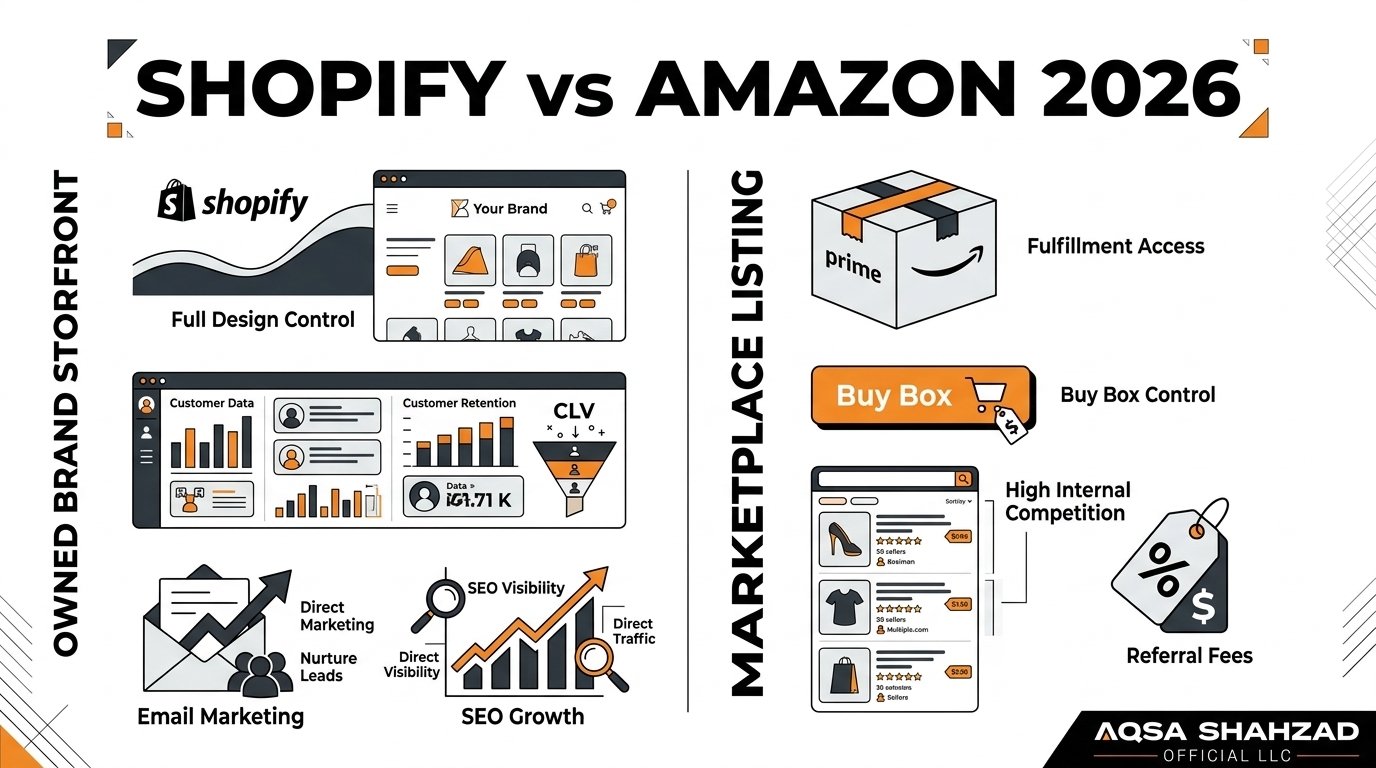
Shopify is an ecommerce platform. You build and run your own branded online store on it. Amazon is a marketplace. You list products next to millions of other sellers, inside a shopping experience Amazon controls.
Both can generate real revenue. Neither is automatically “better.” The right answer depends on what you’re selling, how much capital you have, and whether you’re building a brand or moving inventory.
This guide breaks down the real differences in cost, control, SEO, fulfillment, and long-term profitability, using current 2026 numbers, so you can decide with facts instead of guesswork.
Key Takeaways
- Shopify gives you full ownership of your store, your brand, and your customer data, but you’re responsible for driving your own traffic.
- Amazon hands you instant access to hundreds of millions of shoppers, but you’re renting space in someone else’s store on their terms.
- Shopify’s plans run $29–$2,300+/month (billed yearly) plus card fees as low as 2.25%. Amazon’s Professional plan is a flat $39.99/month plus referral fees of 8–20% per sale.
- Shopify wins on brand control, customer lifetime value, and long-term profitability. Amazon wins on built-in traffic, trust, and speed to first sale.
- Most established DTC brands don’t choose one — they use Amazon for reach and Shopify as the home base for their brand, data, and margins.
Shopify vs Amazon at a Glance
Here’s the short version before we get into the details.
| Category | Shopify | Amazon |
|---|---|---|
| Ownership | You own the store, brand, and platform relationship | Amazon owns the marketplace; you’re a seller within it |
| Customer Data | Full access to emails, phone numbers, and order history | Little to no direct access to buyer contact data |
| SEO | Can rank in Google; builds compounding organic traffic | Ranks inside Amazon’s own search, not Google |
| Branding | Full control over design, packaging, and store experience | Uniform listing template; minimal customization |
| Built-in Traffic | None — you drive your own traffic | Massive built-in audience from day one |
| Fulfillment | Self-fulfilled or a third-party 3PL | FBA (Amazon-fulfilled) or FBM (self-fulfilled) |
| Fees | $29–$2,300+/mo plus 2.25–2.9% card fees | $0.99/item or $39.99/mo plus 8–20% referral fees |
| Best For | Brand builders, DTC, long-term margins | Beginners, fast validation, commodity products |
What Is Shopify? What Is Amazon?
Before comparing costs and features, it helps to be precise about what each platform actually is — because they’re not really competing for the same job.
What Is Shopify?
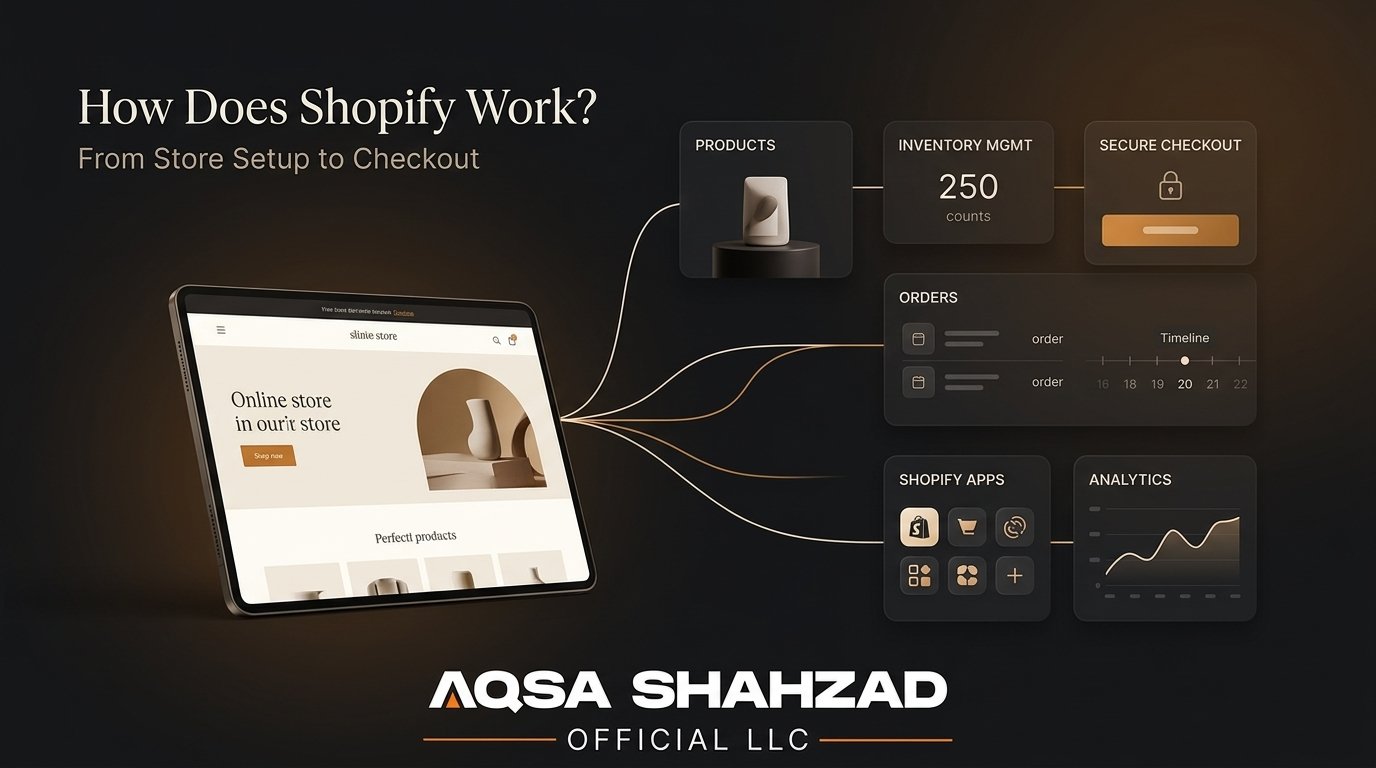
Shopify is a hosted ecommerce platform. It gives you the software to build, design, and run your own online store.
You choose the domain, the design, the checkout experience, and the apps you connect — for email marketing, reviews, subscriptions, or loyalty.
Shopify doesn’t put your products next to a competitor’s identical listing. It doesn’t decide how your brand is presented. You do.
In Q1 2025 alone, merchants on Shopify generated more than $100 billion in GMV in a single quarter, according to Shopify’s own investor relations results — a sign of how much infrastructure now sits behind the platform.
If you want the technical side, our guide on How Shopify Works covers the setup process step by step.
What Is Amazon?
Amazon is the largest online marketplace in the world. For many sellers, it functions less like a store and more like a distribution channel.
You create product listings inside Amazon Seller Central. Amazon’s own algorithm decides how and when your product appears in search results, the Buy Box, and recommendations.
You can fulfill orders yourself through Fulfillment by Merchant (FBM), or let Amazon handle storage, packing, and shipping through Fulfillment by Amazon (FBA).
Independent sellers are the backbone of that marketplace: according to Amazon’s own Seller Central statistics, more than 75,000 independent sellers surpassed $1 million in sales in 2025 alone, and the large majority of everything sold in Amazon’s store comes from sellers like them, not from Amazon itself.
Either way, the customer belongs to Amazon first, and to you second.
Shopify vs Amazon Fees and Pricing (2026 Breakdown)
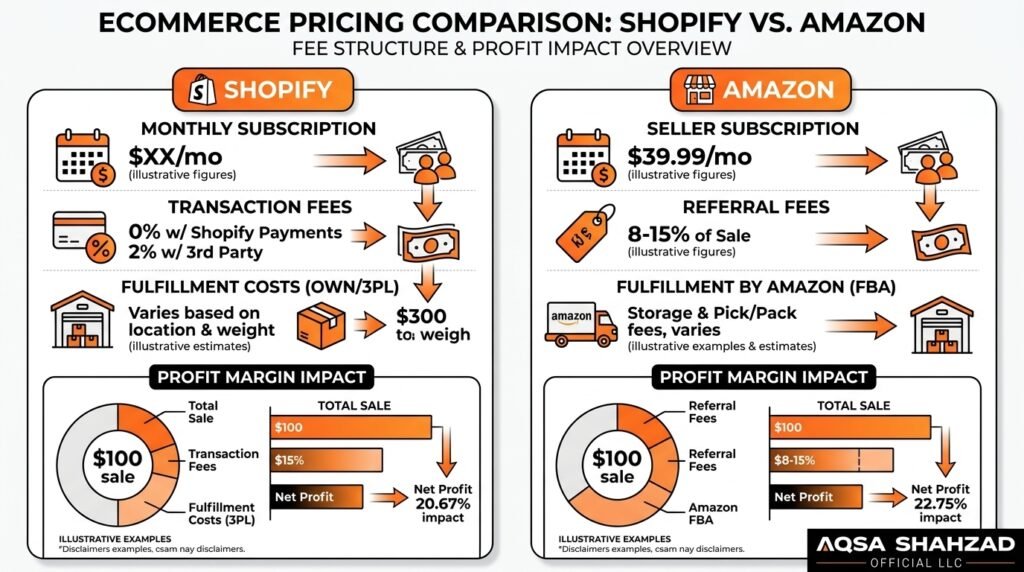
This is the Shopify vs Amazon pricing comparison most guides gloss over. The two platforms charge you in completely different ways.
Shopify charges a flat monthly subscription regardless of how much you sell, plus a small percentage on card transactions. Amazon charges a much smaller flat fee, but takes a percentage of every single sale — whether you sell $1,000 or $1 million a month.
On Shopify, the Basic plan starts around $29/month billed annually ($39/month billed monthly). Grow runs about $79/month annually ($105 monthly), and Advanced sits near $299/month annually ($399 monthly). Card rates drop from 2.9% down to 2.5% as you move up tiers.
Larger, high-volume brands typically move to Shopify Plus, which starts around $2,300/month and adds enterprise features like unlimited staff accounts and higher API limits. Our Shopify Plus Development guide covers that step-up in detail.
On Amazon, the Individual plan costs $0.99 per item sold — only worth it if you’re selling a handful of products a month. Most serious sellers use the Professional plan instead, at a flat $39.99/month.
On top of that subscription, Amazon takes a referral fee on every sale. It typically runs 8% to 20% of the item price depending on category, with most categories landing around 15%.
If you use FBA, you’ll also pay fulfillment and storage fees based on product size and weight. Amazon confirmed in its official 2026 fee update that FBA fulfillment fees rose by an average of just $0.08 per unit this year, with no new fee categories introduced.
So, which is cheaper? At low volume, Amazon’s flat per-sale model can feel lighter, since you’re not paying a subscription for a store nobody’s visiting yet.
But as sales scale, Shopify’s math usually wins. A $50 product sold on Shopify’s Grow plan costs roughly 2.7% plus 30 cents per transaction — about $1.65. The same product on Amazon costs a 15% referral fee — about $7.50. The busier your store gets, the more that gap compounds.
Brand Control and Customer Data: Who Actually Owns the Relationship?
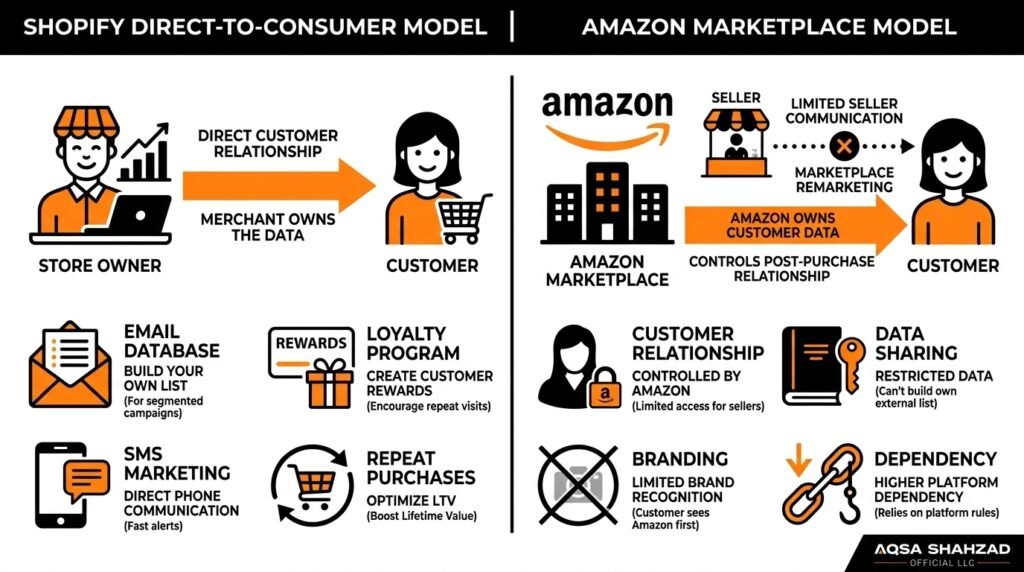
Fees are only part of the equation. What happens to the customer after checkout matters just as much.
On Shopify, every customer who buys from you hands over their email address — and that data is yours. You can email them, retarget them, and market to them again without paying a platform for the privilege each time.
Your store’s design, product photography, and brand voice aren’t diluted by a competitor’s listing one click away.
On Amazon, the customer belongs to Amazon. You typically don’t get their email address, and you can’t run your own retention marketing directly. Your listing sits in a feed next to other sellers offering something similar — sometimes cheaper.
Amazon owns the search algorithm, the reviews system, and the checkout flow. You’re building sales, but not always a relationship you can take with you.
This matters enormously for customer retention and customer lifetime value. A Shopify store lets you nurture a buyer through email and SMS long after the first purchase — something we cover in our Shopify Email and SMS Marketing guide and our Retention and Loyalty Strategy resource.
On Amazon, that second and third purchase often happens. Amazon just gets the credit for it, not you.
Shopify vs Amazon for SEO, Marketing, and Traffic
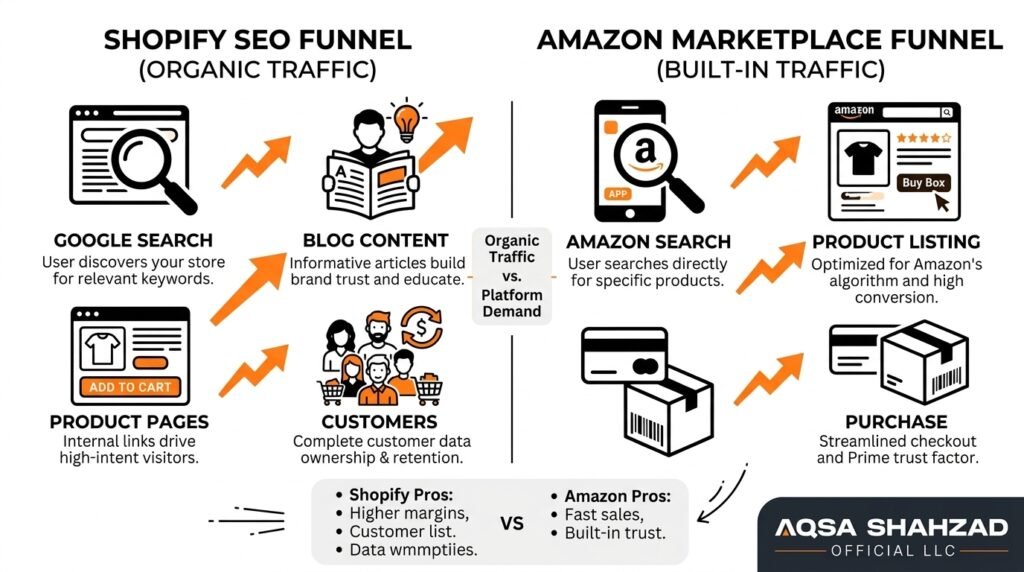
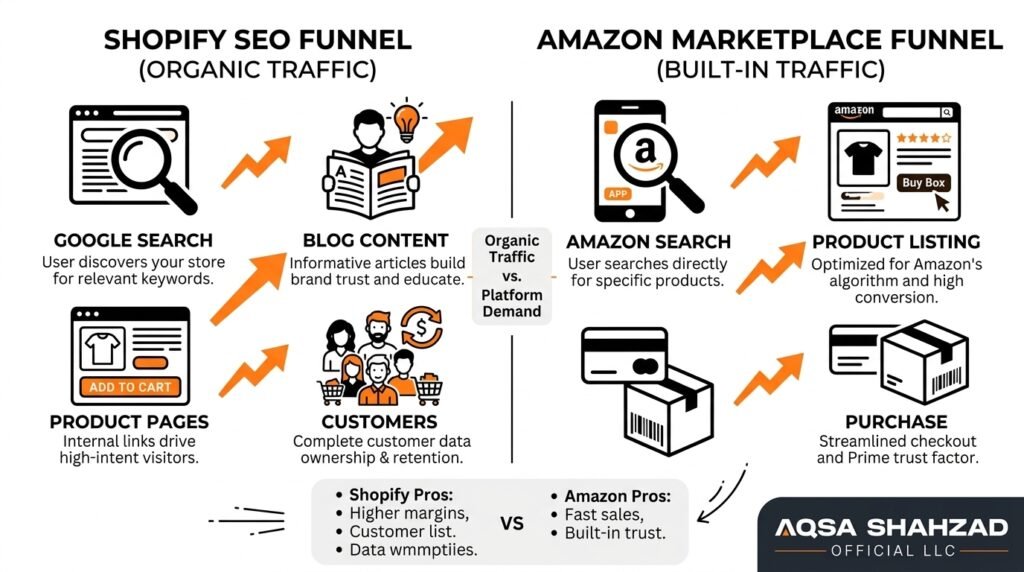
Traffic tells a similar story to customer data. When it comes to Amazon vs Shopify SEO, the two platforms aren’t even playing the same game.
Amazon starts with an enormous built-in audience. Shoppers already trust Amazon, already have payment details saved, and are searching with buying intent. If your product is discoverable and well-reviewed, you can land your first sale within days, with almost no marketing spend.
The tradeoff: you’re competing inside Amazon’s own search engine, where sponsored ads, Buy Box rules, and review volume matter more than classic SEO.
Shopify gives you none of that built-in traffic. A brand-new Shopify store gets zero visitors until you send them there — through Google, social, paid ads, or influencers.
What you get in exchange is a store that can actually rank in Google, build topical authority, and generate free, compounding organic traffic. That takes real ecommerce SEO work: optimized product pages, blog content, fast page speed, and structured data.
If SEO is a priority for your store, our Shopify SEO Agency guide breaks down what that work actually involves.
In short: Amazon gives you demand that already exists. Shopify lets you create demand — and own every visitor who finds it.
Fulfillment: Shopify Shipping vs Amazon FBA and FBM
Getting found is one challenge. Getting the order to the customer’s door is another.
Fulfillment is often the deciding factor for sellers who care more about operations than branding. Amazon offers two paths.
Fulfillment by Amazon (FBA):
- You ship inventory to Amazon’s warehouses; Amazon handles storage, packing, shipping, and returns
- Your products become Prime-eligible, which meaningfully boosts conversion
- Tradeoff: storage fees, long-term storage penalties on slow-moving stock, and less control over the unboxing experience
Fulfillment by Merchant (FBM):
- You ship orders yourself
- You get more control, but forfeit the Prime badge many Amazon shoppers filter for
The Amazon FBA vs Shopify fulfillment question usually comes down to how much of that post-purchase experience you want to own.
Shopify doesn’t fulfill orders itself. You either ship in-house or connect a third-party logistics provider (3PL) through an app. It’s more setup work upfront, but you control packaging, inserts, delivery speed, and the entire post-purchase experience — which feeds directly back into brand perception and repeat purchases.
Bottom line: FBA is closer to a fulfillment shortcut. Shopify plus a 3PL is closer to building fulfillment as part of your brand. Neither is objectively better.
Conversion Rate, Trust, and the Checkout Experience
Fulfillment affects trust after the sale. Conversion rate affects it before.
Amazon typically converts at a higher rate per listing, and it’s not close. Shoppers already trust Amazon’s checkout and already have a card on file.
A new Shopify store has to earn that trust from scratch, through:
- Reviews and social proof
- Fast page speed
- A low-friction checkout
The good news: Shopify checkout conversion is highly controllable. Small, deliberate changes to page speed, mobile layout, and checkout steps can move conversion rate significantly, because you control every pixel of the funnel.
We’ve documented specific tactics in our guide to Shopify Checkout Conversion Rate optimization and our Shopify CRO Audit Checklist, and our Shopify Conversion Rate Optimization service audits exactly where stores lose buyers.
Bottom line: Amazon gives you a conversion rate head start. Shopify gives you the tools to build one that compounds over time.
Scalability and Customization: Shopify Plus vs Amazon Seller Central
Trust and conversion matter early on. Scalability matters once you’re past that stage.
On Shopify, you scale through customization:
- Build custom themes or integrate a headless frontend
- Add subscriptions
- Connect ERP and CRM systems
Eventually, growing brands move to Shopify Plus for enterprise-grade checkout customization, wholesale channels, and higher automation limits. There’s effectively no ceiling on how sophisticated a Shopify store can become, because you’re building on an open platform rather than a more rigid system — see our Shopify vs Magento comparison if you’re weighing platform options beyond Amazon.
On Amazon Seller Central, scaling looks different:
- Add more SKUs
- Expand into new marketplaces
- Use tools like Amazon Advertising and Brand Registry
But the core shopping experience stays uniform. You’re scaling sales volume inside a system whose rules you don’t set — Amazon can change referral fees, search visibility, or Buy Box requirements at any time.
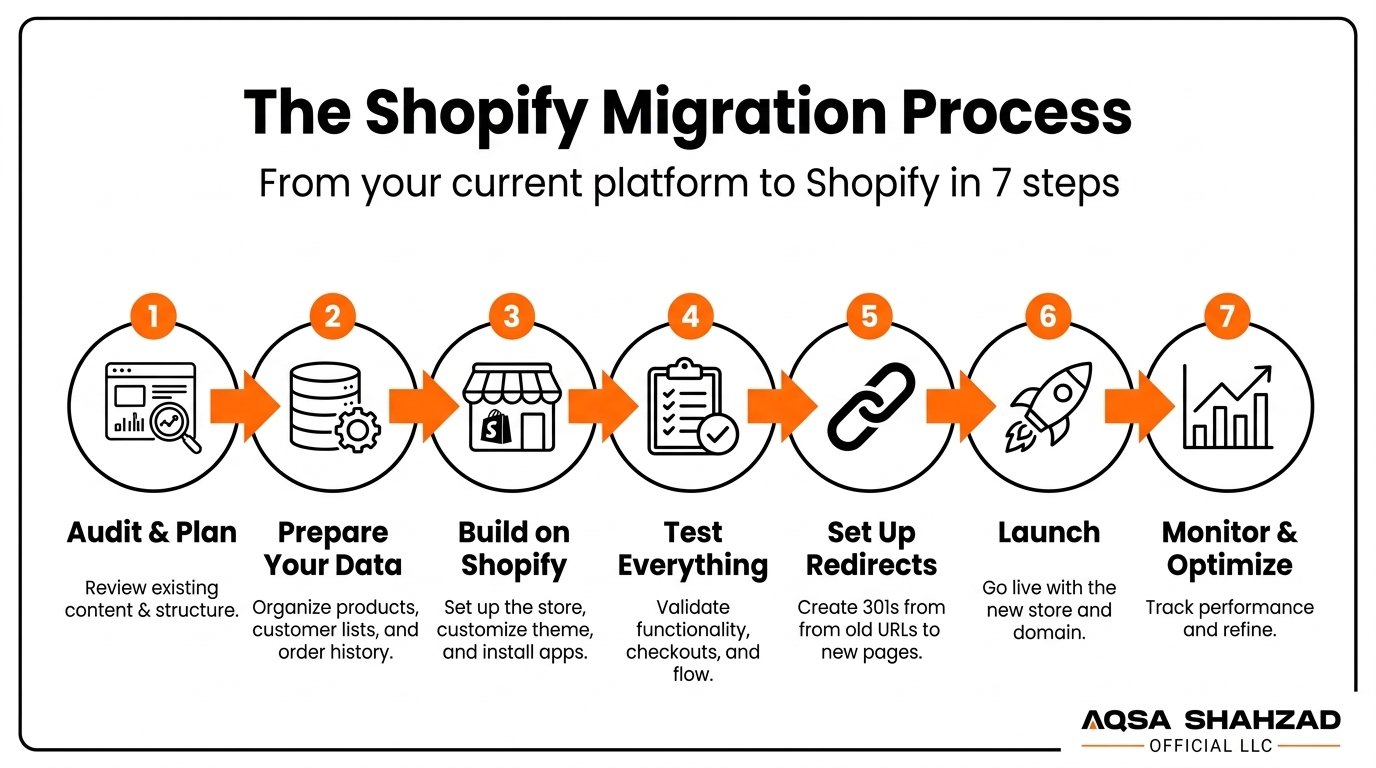
If you’re consolidating sales channels or moving off Amazon-only selling, our Shopify Migration Services guide walks through what that transition actually involves.
Customer Lifetime Value and Long-Term Profitability
Scalability determines how big you can get. Lifetime value determines how profitable that growth actually is — this is where data ownership turns into a number on a spreadsheet.
On Shopify: direct access to customer emails and purchase history lets you run remarketing, loyalty programs, and personalized offers that increase customer lifetime value. Every repeat purchase through your own channels costs a fraction of the first one.
On Amazon: repeat purchases still happen, but Amazon’s recommendation engine and Subscribe & Save program are doing that work, not you — Amazon keeps the relationship regardless of how loyal the shopper becomes. Your customer acquisition cost is often lower upfront thanks to built-in traffic, but your long-term margin is capped by referral fees on every transaction, forever, with no way to reduce that cost through loyalty.
Bottom line: Amazon can be a highly profitable acquisition channel. Shopify is where retention economics work in your favor.
Can You Sell on Shopify and Amazon at the Same Time?
None of this means you have to pick a side permanently.
Yes, you can sell on Shopify and Amazon at the same time — and for many growing brands, this isn’t an either/or decision at all.
A common structure: use Amazon as a top-of-funnel acquisition channel, leaning on its existing traffic and trust to get discovered. Run Shopify as the brand’s real home, where margins are healthier and customer data accumulates.
Shopify supports this with a Shopify and Amazon integration that syncs inventory, orders, and listings between both channels from one dashboard — no need to manage two disconnected systems manually.
Many DTC brands run exactly this hybrid model: acquire broadly on Amazon, then use email, SMS, and retargeting to pull repeat buyers over to Shopify, where the brand experience, and the margin, is entirely theirs.
Our case study on Shopify Plus for jewelry brands shows what that layered approach looks like in a category where brand presentation carries real weight in the buying decision.
The main risk is inventory drift. If stock isn’t synced in real time, you risk overselling on one channel while sitting on unsold units on the other. That’s solvable with the right integration setup — just build it correctly from day one.
Who Should Choose Shopify?
So, who actually wins? It depends which side of the decision you’re on.
Shopify tends to be the better fit when:
- You’re brand-focused. Your packaging, story, and customer experience are part of what you’re selling, not just the product itself.
- You sell premium products. Higher price points justify the work of building trust outside a marketplace feed.
- You want SEO traffic. You’re willing to invest in content and search visibility that compounds for years, instead of renting attention one sale at a time.
- You want to own your customers. Email lists, retention marketing, and lifetime value matter more to you than the fastest possible first sale.
Who Should Choose Amazon?
Amazon tends to be the better fit when:
- You’re a new seller. You want to test the waters without building a marketing engine from scratch.
- You’re validating a product. You need real sales data before investing in a custom storefront and brand assets.
- You sell commodity products. Your item isn’t highly differentiated, and shoppers are comparing mostly on price and reviews.
- You need quick sales. Cash flow matters more right now than long-term brand equity.
For Shopify vs Amazon for beginners specifically, Amazon is usually the lower-risk starting point. The built-in traffic means you can validate demand before spending a dollar on marketing.
Practical Next Steps
Whichever direction fits your business, a few concrete moves will save you time and money.
- If you’re starting from zero, list a small batch of products on Amazon first to validate real demand before investing heavily in a custom storefront.
- If you already have consistent Amazon sales, start building a Shopify store in parallel and begin collecting customer emails immediately. Even a simple pop-up or post-purchase flow builds an asset Amazon never gives you.
- Audit your current checkout and page speed before spending on ads. A slow or confusing checkout undermines every marketing dollar you spend afterward. Our Shopify Audit Tools are a fast way to see where your store currently stands.
- If you’re running both channels, set up inventory syncing before you scale ad spend on either one, so a sales spike on Amazon doesn’t leave your Shopify store oversold.
Not sure where your store stands right now? Get a Free Shopify CRO Audit → — we’ll show you exactly where you’re losing sales and what to fix first.
Frequently Asked Questions
Is Shopify better than Amazon?
Shopify is better if your priority is owning your brand, your customer data, and your profit margins over the long term. Amazon is better if your priority is fast access to an existing audience with minimal setup. Neither is universally “better” — it depends on whether you’re optimizing for control or for reach.
Is Amazon better than Shopify for beginners?
For most first-time sellers testing a product with little capital, yes. Amazon’s built-in traffic and low $39.99/month cost make it easier to get initial sales without building a marketing engine from scratch.
Should I sell on Shopify or Amazon? I
f you have a validated product and want to build a lasting brand, choose Shopify. If you’re still testing demand or want the fastest path to your first sales, start on Amazon. Many sellers eventually use both.
Can I sell on Shopify and Amazon at the same time?
Yes. Shopify offers integrations that sync your inventory, orders, and listings across both platforms, so you can use Amazon for discovery and Shopify as your primary brand and revenue base without managing two disconnected systems.
Which is cheaper, Shopify or Amazon?
It depends on your sales volume. At very low volume, Amazon’s per-item fee can be cheaper since there’s no monthly subscription commitment. Once you’re selling consistently, Shopify is usually cheaper per sale, because its transaction fees (as low as 2.25–2.9%) are significantly lower than Amazon’s 8–20% referral fees.
Is Shopify safer than Amazon?
Both platforms maintain strong security standards, but “safer” means something different on each. On Shopify, there’s no risk of a sudden account suspension shutting down your entire business — a real risk on Amazon, where accounts can be suspended for policy violations, sometimes with limited warning. Amazon, in turn, handles fraud protection and buyer trust for you, which can reduce certain risks for brand-new sellers.
Can Shopify beat Amazon?
Shopify can’t out-traffic Amazon’s built-in audience, and it isn’t trying to. But on margin, brand equity, and long-term profitability, a well-run Shopify store regularly outperforms an equivalent Amazon-only business, since you’re not paying a referral fee on every sale forever.
Conclusion
Shopify and Amazon aren’t really solving the same problem, even though both end in a completed sale.Amazon hands you a ready-made audience and takes a percentage of everything you sell to it, forever. Shopify asks you to build your own audience, but lets you keep almost everything you earn from it once you do.
Online sales made up 17.1% of all U.S. retail spending in the most recent quarter, according to the U.S. Census Bureau’s e-commerce report, and that share keeps climbing. This decision only gets more consequential the longer a business waits to make it deliberately.
Here’s the practical call.
If you’re a beginner, start on Amazon. Validate demand fast, with minimal upfront investment, before you build anything custom.
If you’re a growing brand, start building your Shopify store now, even while Amazon is still your main channel. Every email you collect today is an asset Amazon will never give you.
If you’re an established DTC brand, run both, deliberately. Use Amazon for reach and discovery. Use Shopify as the business you actually own, where the data, the design, and the margin are yours.
Just make sure one of them is actually yours.
Talk to Our Shopify Team → Whether you’re building your first store or scaling to Shopify Plus, we help growing DTC brands get it right.