
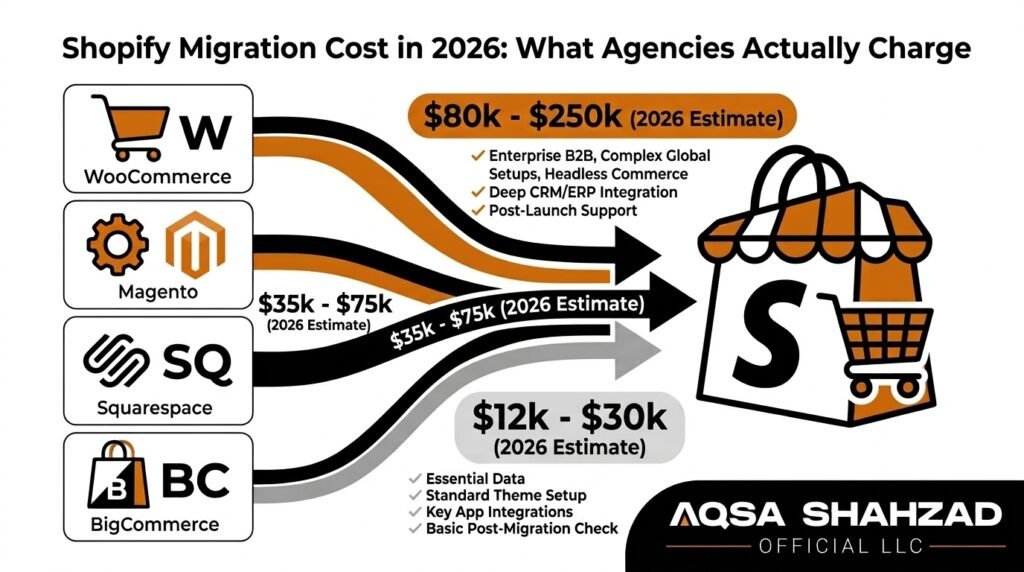
Every store owner asks the same question before committing to a migration: “What is this actually going to cost me?” The honest answer is that shopify migration cost isn’t a single number. It’s a range shaped by your catalog size, your integrations, and how much SEO equity you need to protect. For most US merchants in 2026, that range runs from around $3,000 for a simple Squarespace switch to well over $150,000 for a complex Shopify Plus rebuild.
This guide breaks down exactly where your project falls in that range, what pushes the price up or down, and how to spot a quote that’s quietly missing something important. By the end, you’ll know what a fair number looks like for your specific store.
Key Takeaways
- Shopify migrations typically cost $3,000–$15,000 for small stores, $15,000–$75,000 for mid-market brands, and $80,000–$200,000+ for enterprise Shopify Plus builds.
- Your origin platform changes the price a lot: Squarespace and Wix migrations are the cheapest; Magento migrations are consistently the most expensive.
- Integrations and theme development together usually eat up more than half the total budget.
- Skipping SEO redirects is the most common mistake, and it can cost you 20–50% of your organic traffic.
- Budget an extra 15–20% on top of any quote for near-certain hidden costs like new app subscriptions and staff training.
Shopify Migration Cost at a Glance
Most Shopify migrations in the US fall into three pricing tiers based on store complexity, not just revenue. The platform you’re leaving also shifts the number quite a bit, which the next section covers in detail.
A small store with under 500 SKUs and minimal integrations typically costs $3,000 to $15,000 to migrate. A mid-market store with 500 to 5,000 SKUs, some custom design work, and a handful of third-party integrations usually lands between $15,000 and $75,000. Enterprise stores moving to Shopify Plus, especially those with ERP integrations or multi-currency requirements, commonly spend $80,000 to $200,000 or more.
These numbers reflect the migration work itself, not your ongoing Shopify subscription. You can check current plan pricing directly on Shopify’s official pricing page, since it changes and any blog estimate risks going stale.
Shopify Migration Cost by Platform
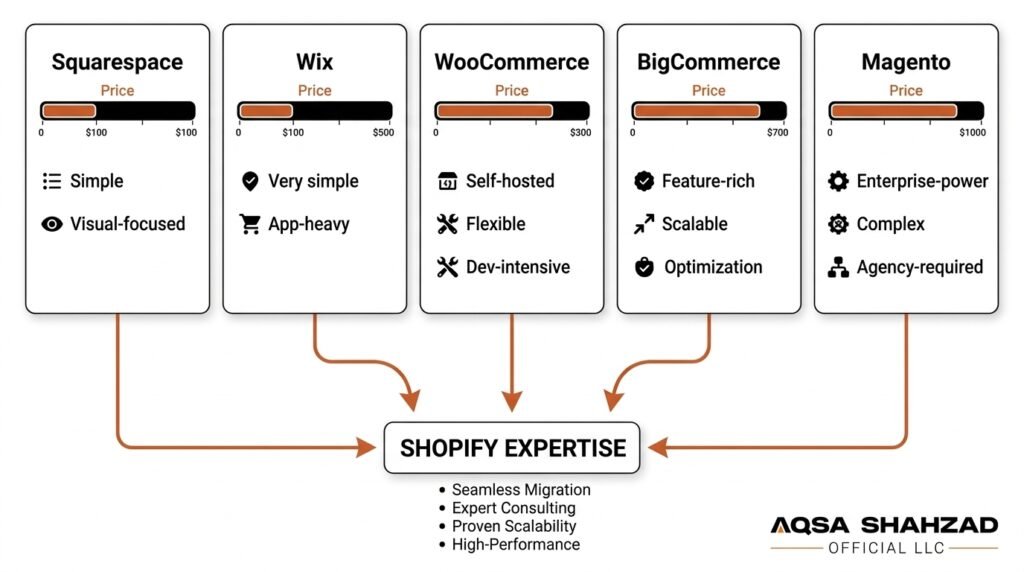
The platform you’re migrating from matters just as much as your store size. A clean, API-friendly platform hands off data easily. A legacy or heavily customized one often means rebuilding logic that was never meant to leave its original system.
| Current Platform | Typical Migration Cost |
|---|---|
| Squarespace → Shopify | $3,000–$15,000 |
| Wix → Shopify | $3,000–$12,000 |
| WooCommerce → Shopify | $5,000–$40,000 |
| BigCommerce → Shopify | $5,000–$30,000 |
| Magento → Shopify | $20,000–$200,000+ |
A squarespace to shopify migration cost sits at the low end because Squarespace catalogs tend to be small with little custom backend logic. A woocommerce to shopify migration cost carries a much wider range, since WooCommerce stores vary enormously in how many plugins they’ve accumulated over the years. A magento to shopify migration cost is consistently the highest, because Magento stores are often self-hosted and deeply customized, requiring real engineering work rather than a simple export-and-import.
Shopify Migration Cost by Business Size
Small business migrations are mostly about clean data transfer and a theme that converts. Most run $3,000 to $15,000, going mainly toward data migration, theme setup, and basic app configuration. The risk here isn’t overspending, it’s skimping on 301 redirects to save a few hundred dollars, which can quietly cost far more in lost traffic.
Mid-market migrations cover the widest range, typically $15,000 to $75,000. A store with 1,000 to 5,000 SKUs, an email platform, and a couple of custom features sits comfortably here. The variance comes down to two things: how custom your design needs to be, and how many systems your store needs to talk to. Coming from Magento or a heavily customized WooCommerce build usually pushes you toward the higher end.
Enterprise and Shopify Plus migrations are a different category entirely, running $80,000 to $200,000+. Multi-currency storefronts, B2B portals, and ERP integrations mean you’re re-architecting a chunk of your commerce stack, not just moving a store. Integration work alone often represents thirty to forty percent of total spend, which is why Shopify Plus development experience matters most at this level.
Which Budget Tier Fits Your Store?
A quick way to sanity-check any quote you receive:
- Small tier: under 500 SKUs, no ERP, standard or lightly customized theme
- Mid-market tier: 500–5,000 SKUs, multiple apps, custom design
- Enterprise tier: Shopify Plus, multi-region, ERP or CRM integrations
If you fall between two tiers, plan toward the higher one. It’s easier to come in under budget than to explain a mid-project scope increase later.
What Actually Drives the Final Price
Five factors explain almost all the variance between quotes:
- Origin platform — modern, API-friendly platforms cost less to migrate than legacy or heavily customized ones.
- Catalog complexity — not just SKU count, but variant structure, since Shopify’s limits sometimes force a rework.
- Design ambition — a customized off-the-shelf theme costs a fraction of a fully bespoke or headless build.
- Integration depth — every third-party tool that needs to reconnect, from email to fulfillment, adds development hours.
- SEO preservation — mapping old URLs, transferring metadata, and protecting rankings you’ve already earned.
That last factor is the one most often cut to save money, and it’s the one that costs the most when it’s missing.
Shopify Migration Cost Breakdown: Where Your Budget Goes
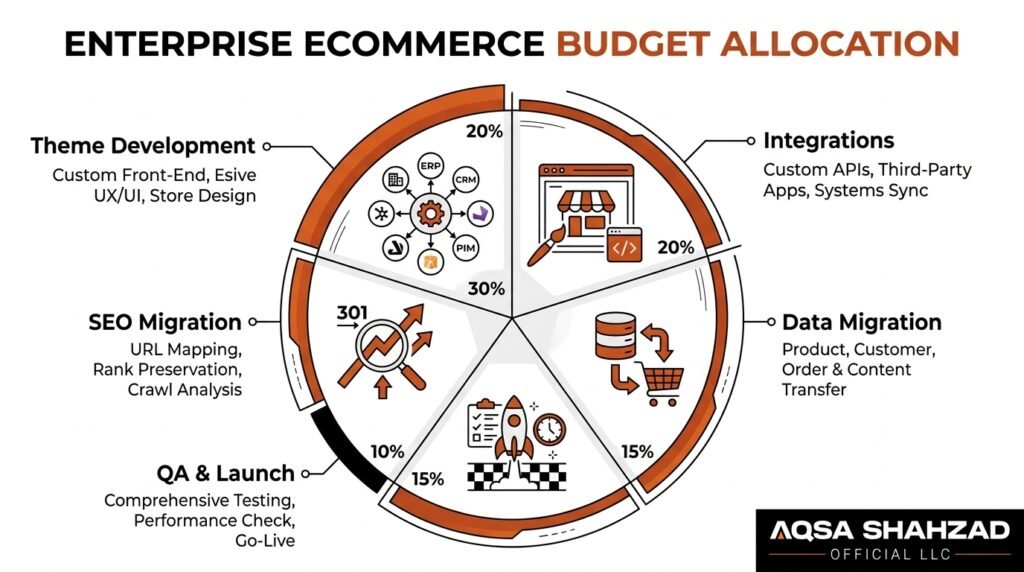
Once you have a total quote, it helps to see how it should typically split across the actual work:
| Cost Category | Typical Share of Budget |
|---|---|
| Data Migration | 10–20% |
| Theme Development | 20–35% |
| Integrations | 20–40% |
| SEO Migration | 10–15% |
| QA & Launch | 10–15% |
If a quote allocates almost nothing to SEO migration or QA, that’s worth questioning rather than celebrating as a discount.
Why Shopify Migration Quotes Differ So Much
If you’ve gotten quotes that don’t seem related to each other at all, one agency at $15,000 and another at $50,000 for what feels like the same project, you’re not imagining it. It usually comes down to a few specific factors:
- Agency location — US-based teams with senior Shopify Plus developers typically price higher than offshore teams.
- Shopify Plus expertise — agencies with real enterprise migration experience price in the risk mitigation they bring.
- Assumptions about custom development — one agency assumes bespoke code where another assumes an app can handle it.
- Integration complexity — less experienced teams often quote before actually auditing your ERP or CRM connections.
- SEO scope — some agencies include full redirect mapping by default; others treat it as a costly add-on.
The fix isn’t chasing the lowest number. It’s asking each agency what’s included, line by line, before you compare price at all.
Shopify Migration Timeline: How Long Does It Actually Take
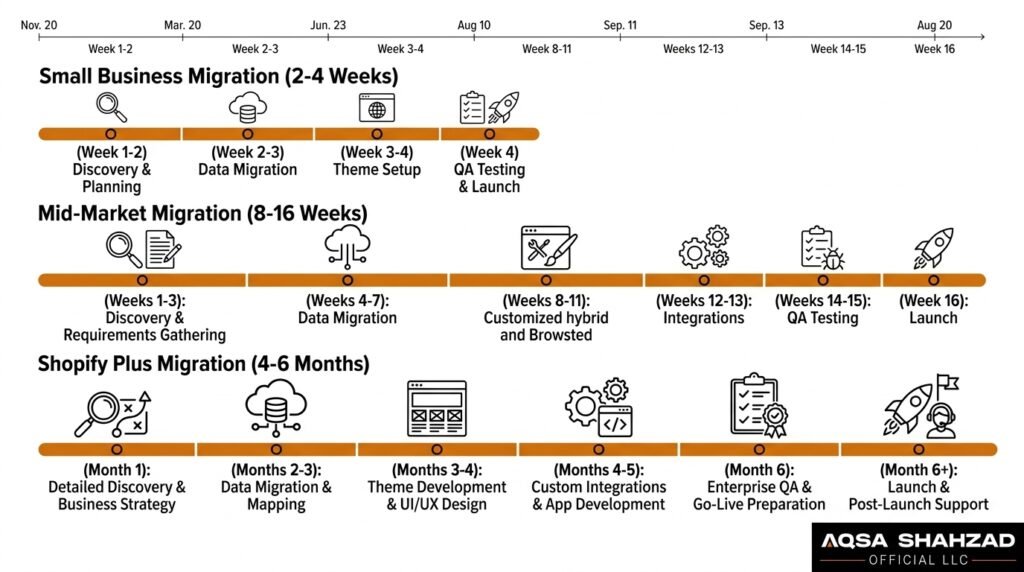
Cost and timeline move together. A small store migration typically takes two to four weeks. Mid-market projects with custom design and integration work usually run eight to sixteen weeks, largely due to design iteration and QA testing across devices.
Enterprise Shopify Plus migrations generally take four to six months, since they involve phased rollouts and extensive integration testing before a full cutover. A realistic shopify migration timeline should always include buffer time for cleanup and post-launch fixes. Anyone promising a complex enterprise migration in three weeks is either underscoping the work or planning to cut corners you’ll discover later.
Hidden Costs Most Quotes Leave Out
A base migration quote often doesn’t include everything you’ll spend before your store is fully live:
- New app subscriptions — $2,000–$10,000, since old-platform plugins rarely have a free Shopify equivalent
- Staff training — $3,000–$8,000 for a mid-sized team learning a genuinely different backend
- Post-launch support — typically another 15–20% on top of the base quote for real-world bug fixes
A sensible rule of thumb: budget a 15–20% contingency on any migration quote, regardless of size, for these near-certain extras.
DIY Migration Tools vs. Hiring an Agency
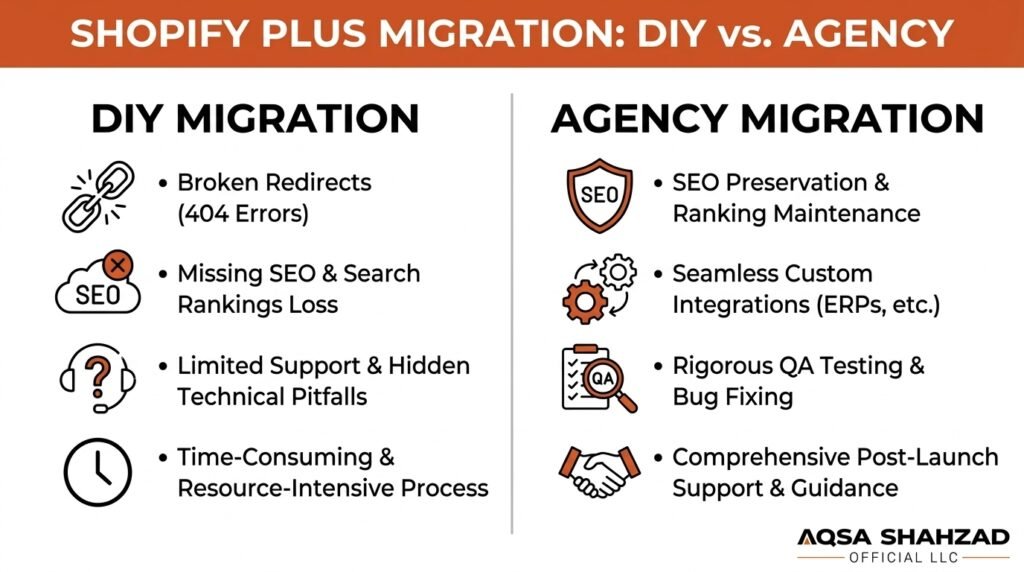
Automated migration apps can move basic data for a few hundred dollars, and for a very small, simple store, that might genuinely be enough. But DIY tools don’t handle 301 redirect mapping properly, and they don’t preserve metadata the way search engines expect.
Stores that go DIY on anything beyond the simplest catalog commonly see twenty to fifty percent drops in organic traffic within months, purely from broken redirects. For any store doing meaningful revenue, working with a team offering dedicated Shopify migration services isn’t an upsell, it’s what protects the revenue you’ve already built.
Real Shopify Migration Examples
Seeing the tiers as actual projects makes the pricing feel less abstract:
- Squarespace, 150 SKUs, standard theme → around $5,000
- WooCommerce, 2,500 SKUs, Klaviyo + Recharge → around $28,000
- Magento → Shopify Plus, full ERP integration → around $120,000
For a closer look at enterprise-level complexity, our Shopify migration case study walks through connecting a Shopify Plus storefront to a live booking system without disrupting either. Migrating from a marketplace instead of a storefront platform brings its own hurdles too, covered separately in our Amazon to Shopify migration guide.
How to Control Costs Without Cutting Corners
A few habits separate merchants who get good value from those who get surprised later:
- Audit your data first — know your real SKU count and active integrations before requesting quotes.
- Treat SEO as non-negotiable — it protects more revenue than almost any design choice.
- Phase custom features — launch on a strong theme, then add bespoke work once you have real usage data.
- Ask for itemized quotes — a broken-down proposal is far easier to evaluate honestly than one flat number.
Want a starting number before talking to anyone? Our pricing calculator gives you a realistic range in a few minutes.
Final Thoughts
Shopify migration cost comes down to your platform of origin, catalog complexity, integration needs, and how seriously you take SEO preservation. A small store might reasonably spend $5,000; an enterprise brand with ERP integrations might reasonably spend $150,000. Both can represent good value if the work matches the price. Our platform migration services are built around itemized scoping and realistic timelines, so there are no surprises after launch.
Frequently Asked Questions
How much does a basic Shopify migration cost for a small store?
For a store with under 500 SKUs and minimal integrations, expect $3,000 to $15,000. Confirm SEO redirects are included rather than treated as an extra.
Is it cheaper to migrate from Squarespace to Shopify than from Magento?
Yes, significantly. A squarespace to shopify migration is faster and cheaper because Squarespace stores have simpler product structures. Magento migrations involve untangling custom code, often pushing costs into the tens or hundreds of thousands.
Why do Shopify migration quotes vary so much between agencies?
Quotes differ based on agency location, Shopify Plus expertise, assumptions about custom development, and SEO scope. Ask for an itemized breakdown rather than comparing totals alone.
How long does a Shopify Plus migration typically take?
Usually four to six months, factoring in ERP integrations, QA across devices, and a phased rollout before full cutover.
Will I lose my search rankings during a Shopify migration?
You can, if 301 redirects and metadata aren’t handled correctly, sometimes seeing twenty to fifty percent traffic drops. Proper SEO mapping done during the migration is the most effective protection.
What’s included in a typical Shopify migration quote?
Data migration, theme development, integrations, SEO redirect mapping, and post-launch support, roughly in the proportions shown in the cost breakdown table above.