Shopify SEO agency
Shopify SEO agency in the USA: technical SEO, content and AI search.
Aqsa Shahzad Official is a Shopify Select Partner that builds and maintains Shopify stores, and runs their SEO as a monthly retainer. Theme fixes, redirects and structured data are changed in the store’s code by the same team that builds stores. Each month we also test whether ChatGPT, Perplexity, Gemini and Claude cite the store when your buyers ask about what you sell. From $3,500 a month.

 5.0 on Shopify Partners · Premier Verified on Clutch
At a glance
The Shopify SEO retainer in seven lines.
Each line is covered in more detail further down the page.
- What it is
- A monthly SEO retainer for Shopify and Shopify Plus stores.Technical SEO, content, internal linking and structured data, plus generative engine optimisation (GEO): the work that decides whether AI assistants can find, read and cite your store.
- Who it is for
- Brands that want organic traffic to grow every month.Usually stores that already sell, have a catalogue Google has only partly indexed, and want one team to own search as an ongoing job rather than a one-off audit.
- Who does the work
- The team that builds Shopify stores.Product links, structured data, pagination and app scripts live in the theme, so fixes are made in the code without a hand-off to a separate developer.
- What runs monthly
- Crawl, fix, write, link, test, report.Technical crawl and fixes · content briefs, pages and collection copy · internal linking · structured data · AI visibility testing · a written report covering search and AI answers.
- How AI visibility is measured
- Your buyers' questions, run through the assistants every month.We record whether you appear, which URL is cited, and whether what is said about you is accurate.
- Investment
- From $3,500 per month.Included from the Growth tier when bundled. Three-month initial term, then month to month, cancellable with 30 days' notice.
- What it is not
- Not link buying, not spun content, not a ranking guarantee.Nobody controls Google's rankings or what an assistant writes, and anyone selling a guaranteed position is selling risk.
SEO on Shopify
What is different about SEO on a Shopify store.
Shopify handles sitemaps, canonical tags and a default robots.txt. These six are left to the theme, the apps and you.
- 01
Duplicate product URLs
Every product loads at /products/handle and again inside each collection it belongs to, at /collections/collection-handle/products/handle. Shopify points the canonical tag at the /products/ address. Themes that use Liquid's
within: collectionfilter link product cards to the collection address instead, so most internal links point at the copy Google is told to ignore. We change those links to the canonical address. - 02
Filtered, sorted and tagged collections
Filters, sort orders and tags turn one collection into many URLs. Shopify's default robots.txt already blocks sorted URLs and combined-tag URLs. We check in Search Console what your theme's filters and apps actually generate, and edit robots.txt.liquid only where the default misses something, because Shopify treats changes to that file as an unsupported customization.
- 03International expansion
Sitemaps, Markets and hreflang
Shopify generates sitemap.xml for products, collections, pages and blog posts, with a separate sitemap for each international domain, and each domain has to be submitted in Search Console on its own. Shopify also writes hreflang tags for every international domain or subfolder. We check that each market's pages have translated titles and descriptions rather than the default language.
- 04Platform migration
Redirects on migrations and retired products
A Shopify redirect only fires when the old URL no longer loads a page, and a store can hold 100,000 of them (20 million on Shopify Plus). We build the redirect map URL for URL when a store moves to Shopify or products are retired, then check the old URLs in Search Console after launch.
- 05Speed optimization
Apps, scripts and speed
Each app can add scripts to every page, and an app removed from the store can leave its code in the theme. We read Core Web Vitals from field data, remove unused app code and fix slow templates in the theme itself.
- 06
Structured data
The theme and several apps can each print Product, Offer and review markup, sometimes the same type twice. We keep one source for each type, add BreadcrumbList and Organization markup where it is missing, and validate the result in Google's Rich Results Test.
What the retainer covers
Shopify SEO services in scope.
Eight areas of work. Your written scope says which of them your store needs first.
- 01
Technical SEO
Crawl, indexation, canonical tags, redirects, pagination, robots.txt.liquid and Core Web Vitals.
Free Shopify SEO audit - 02
Collection and product pages
Collection intro copy and FAQs, product titles, descriptions and image alt text, each written for the searches that page should rank for.
- 03
Content
Guides and blog posts briefed against mapped queries, and existing pages refreshed with their URLs kept.
- 04
Internal linking
Navigation, breadcrumbs and links inside content pointed at the pages that sell.
- 05
Structured data and entities
Product, Offer, BreadcrumbList, Organization and FAQ markup, validated, with one source per type.
- 06
Migrations and redesigns
Redirect maps and a pre-launch crawl, so a new theme or platform keeps the rankings the old one earned.
Platform migration - 07
AI search (GEO)
Crawler access, facts written so assistants can quote them, an llms.txt file and monthly tests in the assistants.
AI visibility audit - 08
Reporting
Search Console, GA4 and the assistant tests in one written report, sent before the monthly call.
The month
What ships each month.
- 01
Crawl and fix
A crawl every week. New 404s, redirect chains, orphaned pages, broken canonicals and invalid structured data are fixed before they spread.
- 02
Content and entity work
One or two pages briefed, written or optimised against a mapped query, with schema and entity markup shipped alongside.
- 03
AI visibility test
Your buyers' questions run through the major assistants. Presence, cited URL and factual accuracy are recorded and tracked month to month.
- 04
Report
Rankings and organic traffic, AI citation presence and accuracy, what shipped and what is next. Sent before the call.
How it starts
From the free audit to month three.
Five steps. The first two cost nothing.
- 01
The free audit
Run the free Shopify SEO audit or send us the store URL. Send us the result from the report and you get a written answer from an engineer within 12 hours.
- 02
A call, then a written scope
A 30-minute call. After it you get a written scope: the monthly price, the first quarter's priorities and what is out of scope. Nothing is billed before you have it.
- 03
Access
A collaborator request in your Shopify admin, which you approve without sharing a password, plus access to Search Console and GA4. If Search Console is not set up, we set it up and submit the sitemap.
- 04
Month one
A full crawl, the baseline for rankings, organic traffic, indexed pages and assistant answers, and the first fixes.
- 05
Months two and three
Fixes, content and linking from the scope, reported against the month-one baseline. After the three-month term the retainer rolls monthly.
AI search (GEO)
Being cited in AI answers is part of the same retainer.
Search engines and assistants read the same pages. GEO adds crawler access, quotable facts and monthly testing in the assistants.
SEO only
Optimised for a results page and nothing else
- AI crawlers are blocked or never considered in robots.txt, so the store cannot be cited however good the content is
- Key facts exist only in prose, which does not survive extraction into an answer
- Pages never name the products, platforms or problems a question is about, so nothing connects them to it
- Claims appear only on your own site, with nothing elsewhere to corroborate them
- Assistants describe the business incorrectly and nobody checks
- Reporting is clicks only, so an answer that named you without a click is invisible
SEO and GEO together
Optimised for a ranked link and for being the cited source
- Search crawlers allowed and checked in robots.txt, not assumed
- Fact blocks on every commercial page: price, scope, timing and terms in lines an assistant can lift
- Entity markup naming the real products, platforms and organisations on the page
- An llms.txt file listing the pages and facts you want assistants to use
- Monthly assistant tests on your buyers' questions, with wrong answers tracked and fixed on the page
- Reporting on both: rankings and traffic, plus citation presence and accuracy
Crawler access
Which crawlers to allow, and what blocking each one does.
Robots.txt rules written before these crawlers existed often block the wrong ones.
| Crawler or token | Run by, and for | What a Disallow rule does |
|---|---|---|
| OAI-SearchBot | OpenAI · ChatGPT search | Your pages are not shown in ChatGPT search answers. They can still appear as plain navigation links. |
| ChatGPT-User | OpenAI · pages a ChatGPT user asks it to open | Not a search setting. OpenAI says robots.txt may not apply to these user-initiated visits and points to OAI-SearchBot for search opt-outs. |
| PerplexityBot | Perplexity · search index | Your pages are not surfaced or linked in Perplexity's search results. Perplexity-User, which fetches a page for one user's question, generally ignores robots.txt. |
| Claude-SearchBot | Anthropic · Claude search index | Anthropic says blocking it can reduce how visible and how accurately described you are in Claude's search results. |
| Claude-User | Anthropic · pages fetched for a user's question | Claude cannot retrieve your page to answer that user. |
| Googlebot | Google Search, including AI Overviews and AI Mode | Blocking it removes you from Google Search and its AI features alike. AI Overviews need no extra markup: a page that is indexed and eligible for a snippet can appear. |
| Google-Extended | Google · Gemini training and grounding (a robots.txt token, not a separate crawler) | No effect on Google Search, AI Overviews or rankings. Google states it does not change a site's inclusion in Search and is not a ranking signal. |
| GPTBot / ClaudeBot | OpenAI / Anthropic · model training | Keeps future content out of training. It does not remove you from ChatGPT or Claude search, and blocking them is a legitimate privacy choice. |
Checked against the OpenAI, Anthropic, Perplexity and Google documentation in November 2026. Search crawlers and training crawlers are separate decisions: blocking a training crawler does not affect AI search, and blocking a search crawler does.
Proof
SEO results on Shopify stores we build and maintain.
Both are retainer clients of three years. The numbers come from the published case studies.
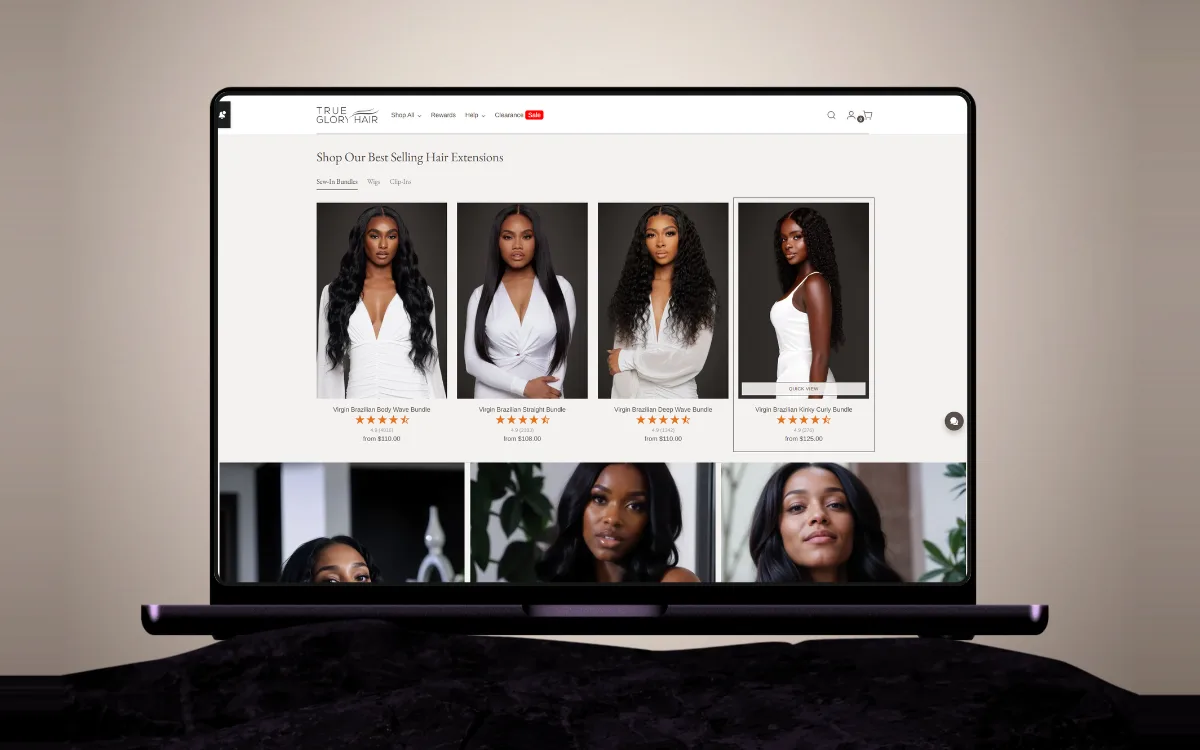
True Glory Hair is a wig brand on a Shopify Plus store we built. Its SEO consultant sends recommendations as a sheet: page refreshes, new collections, redirects and meta titles. We make each change in the store, keep every URL and check the redirects in Search Console. The four numbers below are from that programme.
- 01
21 pages refreshed
Rewritten from the consultant's copy with every URL kept, so nothing the page had earned was lost.
- 02
61 titles and descriptions
Written by the consultant, set in the store in a single pass.
- 03
7 competing URLs
Redirected to one winning page each, and the menu now links only to those winners.
- 04
11 new collections
Built with intro copy and an FAQ, for queries like HD lace and ready-to-wear wigs.
Case study
True Glory Hair: SEO changes shipped every month on a Shopify Plus wig store
- Shopify Plus
- SEO implementation
- 3 years

Case study
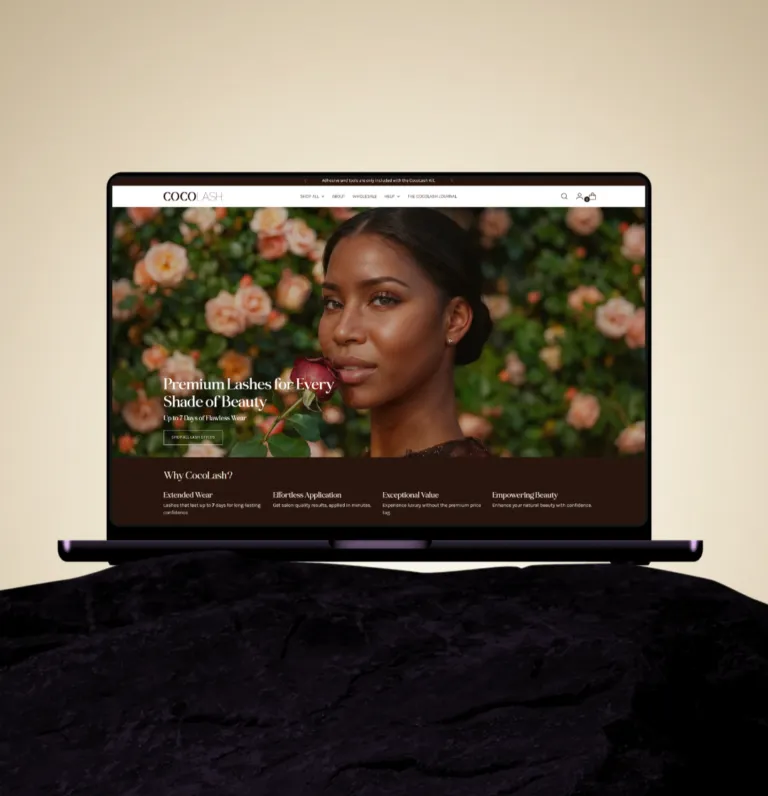
CocoLash: one content structure for ten product pages, and three years on retainer
- Build + retainer
- Product content system
- +63% organic traffic
CocoLash's organic traffic rose 63% across the engagement, with one content structure for all ten product pages. All case studies.
Checkable proof
Four places to check this agency that we do not control.




Investment
One retainer, search and AI answers.
Shopify SEO and GEO retainer
Weekly technical crawl and fixes, monthly content and entity work, structured data maintenance, internal linking, monthly AI assistant testing, and one written report covering organic search and AI citation.
A starting point for scoping rather than a quote. The price depends on site size, catalogue depth, how competitive the searches are and how much content production is in scope. Content we write is included at the volumes stated in your scope; larger programmes are priced accordingly. The retainer is included from the Growth tier when bundled with development.
How to choose a Shopify SEO agency
Five questions to ask any Shopify SEO agency.
With our own answer to each.
- 01
Who edits the theme?
Most Shopify SEO fixes are code changes: product links, structured data, pagination, app scripts. If the agency cannot edit Liquid, every fix waits for a developer. Here the same team does both.
- 02
Does it promise a position?
Google says nobody can guarantee a number-one ranking. A promised position is a reason to walk away. We commit to the work, the baseline and a monthly report against it.
- 03
Where do the links come from?
Bought links break Google's spam policies and can cost a store its rankings. Ask how authority is built. We do not buy links.
- 04
Whose accounts hold the data?
Search Console, GA4 and the reports belong in the brand's own accounts, so nothing is lost if the agency changes. We work in yours.
- 05
What happens on a redesign or migration?
Ask to see the redirect map and the pre-launch crawl before launch day. Both are part of our migration scope.
Questions brands ask a Shopify SEO agency.
Is Shopify good for SEO?
Yes, with known limits. Shopify generates the sitemap, sets canonical tags, lets you edit every title, description and URL handle, and ships a sensible default robots.txt. The limits are the fixed URL prefixes (/products/, /collections/, /pages/, /blogs/), which cannot be removed, plus the duplicate product paths and app scripts described above. None of them stops a Shopify store from ranking.
What does a Shopify SEO agency do each month?
Here: a weekly crawl with fixes made in the theme, one or two pages briefed, written or optimised, internal linking and structured data upkeep, a test of your buyers' questions in the AI assistants, and a written report before the monthly call.
What is generative engine optimisation, in plain terms?
Getting your brand named and cited when someone asks an AI assistant a question instead of typing it into a search box. Classic SEO competes for a position in a list of links. GEO competes to be the source the assistant uses when it writes an answer. The foundations overlap heavily — technical health, clear content, credible corroboration — but GEO adds retrievability: whether a machine can reach your page, extract a clean fact from it and trust it enough to repeat it with your name attached.
Can you guarantee we will rank first, or be cited?
No, and treat anyone who does with suspicion. Nobody controls a search ranking and nobody controls what a language model composes. What we commit to is the work that measurably improves the odds — technical health, correct entity and schema markup, retrievable content structure, crawler access, and monthly measurement of both channels so you can see movement rather than take our word for it.
How do you measure AI visibility when there is no rank tracker?
We run a fixed set of your real buyer questions through the major assistants each month and record three things: whether you appear at all, which URL is cited, and whether what is said about you is factually accurate. Tracked over time that shows movement clearly. The accuracy column matters as much as the presence one — an assistant confidently describing you incorrectly is a problem you can only fix on-page.
Should we block AI crawlers to protect our content?
That is two decisions. Training crawlers such as GPTBot and ClaudeBot collect data to train models; blocking them is a legitimate choice and does not affect whether you appear in AI search. Search crawlers such as OAI-SearchBot, PerplexityBot and Claude-SearchBot build the indexes those assistants search when they answer; blocking them keeps you out of those answers. Google-Extended only covers Gemini training and grounding, and changes nothing in Google Search, AI Overviews included.
Do we need Shopify SEO apps?
Some. An app is useful for jobs such as bulk meta editing or image compression. Most technical fixes are better made in the theme, because every app can add scripts to every page. Our list of the best Shopify SEO apps says which job each one is for.
Will moving to Shopify cost us our rankings?
Not if every old URL is redirected to its closest new page and the new store is crawled before launch. Google says rankings can move for a while after a site move while it re-crawls. The redirect map is part of every platform migration we run.
How is this different from your strategy and analytics service?
The strategy, SEO and analytics service is fixed-scope project work — a full audit, a migration plan, an analytics rebuild. This retainer is the ongoing programme: monthly crawling, content, entity work and AI visibility testing. Brands often do the audit first and move onto the retainer to execute against it.
How long before we see results?
Technical fixes can move things within weeks. Content and authority work realistically takes three to six months to show clearly in organic traffic, which is why the initial term is three months and why we report leading indicators — indexation, crawl health, citation presence — rather than asking you to wait for revenue to confirm it. AI citation can move faster than rankings, because retrievability is often a fixable blocker rather than a competitive one.
Do you only work with Shopify Plus stores?
No. The retainer runs the same way on standard Shopify and on Shopify Plus. Plus mostly changes the scale of the work: a bigger catalogue, more templates to keep crawlable and, often, more than one market.
Does SEO replace our paid ads?
Not overnight, and it does not have to. Paid media buys attention this week; organic rankings and AI citations build month on month, so over time a growing share of revenue arrives without a cost per click.
What do you need from us to start?
Collaborator access to the Shopify admin, which you approve without sharing a password, and access to Google Search Console and GA4. If the store has an SEO consultant or an existing keyword list, that too.

Shopify Plus experts
Let's talk Shopify, Shopify Plus and the store you actually want.
An accredited Shopify Plus agency that designs, builds, migrates, supports and grows stores for brands that have outgrown templates. Ready when you are: talk to an engineer about the project.
Get in touch