
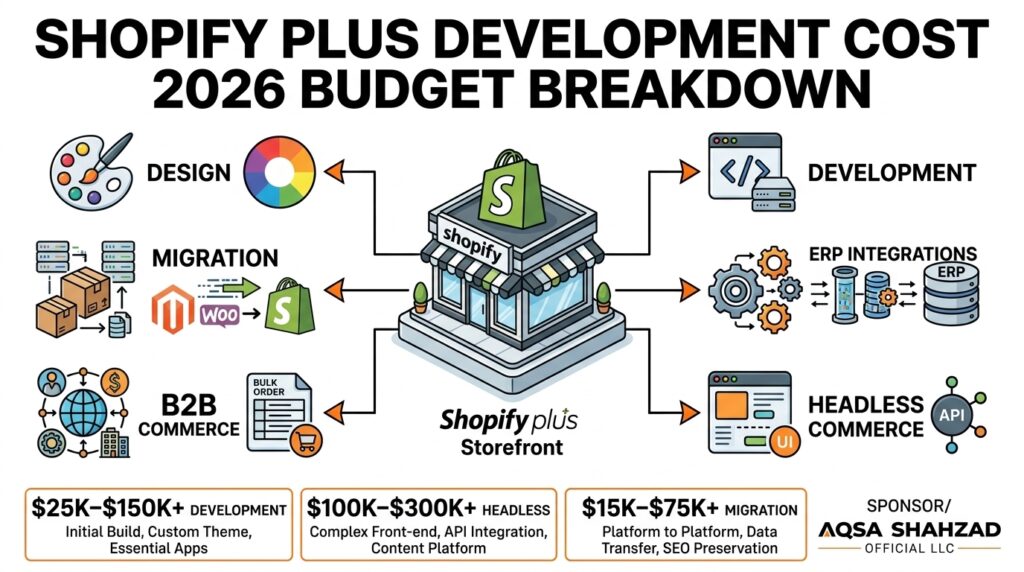
Most brands asking about Shopify Plus pricing find one number fast: the monthly subscription. That number is easy to find, but it doesn’t tell you what you’ll spend in your first year. The subscription gives you the platform. It doesn’t design your storefront, move your data, connect your ERP, or build the wholesale portal your sales team has been asking for.
That’s why Shopify Plus development cost gets misjudged so often. A brand budgets about $30,000 a year for the license, then gets a build quote for three or four times that and assumes something is off. Usually nothing is off. The two numbers pay for different things, and they come from different places. Shopify sets the platform fee. The development budget depends on your scope, your systems, your catalog, and the team you hire.
This guide separates those costs, gives realistic 2026 ranges and timelines for U.S. brands, and explains what pushes a quote up or down, so you can plan a budget before you talk to a single vendor.
Key Takeaways
Typical Shopify Plus development cost: Most U.S. Shopify Plus builds land between $25,000 and $150,000. Complex replatforms and headless builds often go past $150,000–$300,000+. These are industry estimates, not official Shopify prices.
Shopify Plus platform cost: Shopify’s official Plus pricing starts at $2,300/month on a three-year term or $2,500/month on a one-year term. Larger businesses may pay a variable, revenue-based platform fee instead.
Development is not included: The subscription covers the platform. Design, development, migration, and integrations are separate costs.
Typical timeline: Most Shopify Plus projects take 8–16 weeks. B2B implementations take 12–24 weeks, and headless or enterprise replatforms take 4–9 months.
Major cost drivers: Custom design, ERP/CRM/WMS integrations, B2B requirements, catalog size, migration complexity, custom apps, multiple markets or storefronts, and headless architecture.
Typical migration cost: About $15,000–$75,000+ as part of a larger project, depending on data volume, the source platform, and how many URLs need SEO redirects.
Typical integration cost: About $5,000–$15,000 for a standard connector setup, and $20,000–$60,000+ for a custom ERP or middleware integration.
Headless cost considerations: Headless builds (for example, with Shopify Hydrogen) usually cost $100,000–$300,000+ and need more ongoing engineering than a theme-based build.
What to budget for: Year one = platform fees + build cost + apps + 10–20% contingency + post-launch support.
| Cost Item | Typical 2026 Range | Source |
|---|---|---|
| Shopify Plus subscription | $2,300–$2,500/month (starting) | Official Shopify pricing |
| Initial development | $25,000–$150,000+ | Industry estimate |
| Migration | $15,000–$75,000+ | Industry estimate |
| Integrations (each) | $5,000–$60,000+ | Industry estimate |
| Ongoing support/retainer | $2,000–$15,000+/month | Industry estimate |
What Is Shopify Plus Development Cost?
Shopify Plus development cost is the total you pay to plan, design, build, connect, test, and launch a store on Shopify Plus. It’s the cost of the work done on the platform, not the cost of the platform. That difference matters because buyers often compare quotes as if they cover the same things, and they rarely do.
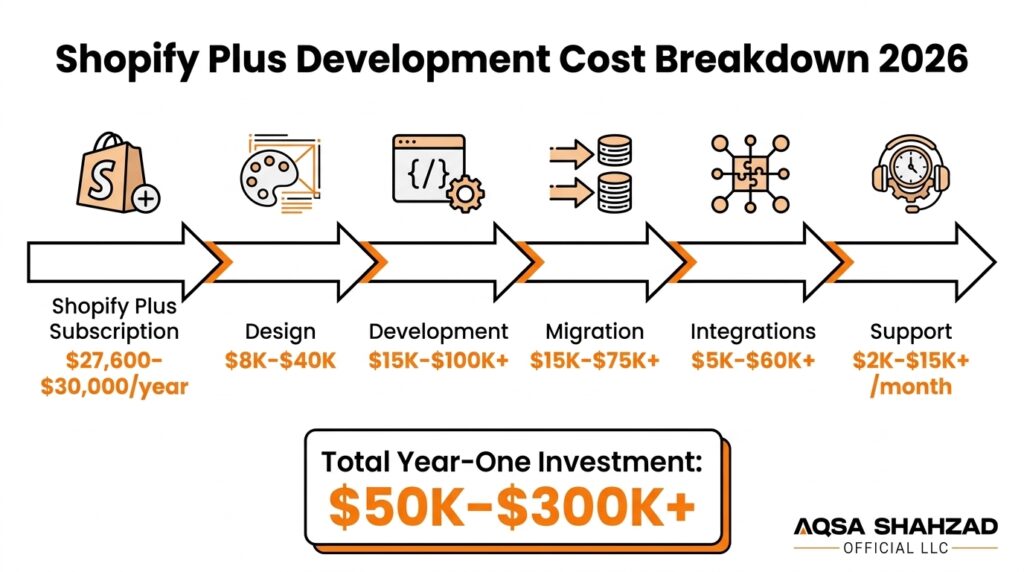
It helps to split the budget into six parts. The platform cost is your Shopify Plus subscription, paid to Shopify. The design cost covers UX research, wireframes, and visual design. The development cost is theme building, custom features, and technical setup. The migration cost covers moving products, customers, orders, content, and redirects from your old platform. The integration cost connects Shopify to your ERP, CRM, warehouse, and marketing tools. The ongoing operating cost includes apps, maintenance, and continued development after launch.
When two vendors give very different quotes, one of them is often leaving out migration, integrations, or QA. Reading the scope line by line is how you find the real difference.
How Much Does Shopify Plus Development Cost in 2026?
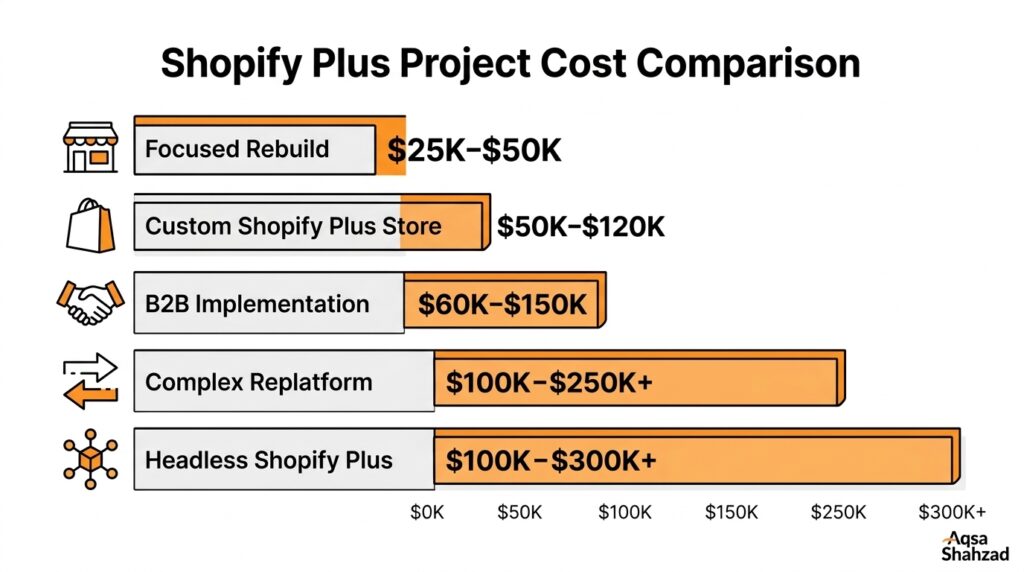
For most U.S. ecommerce brands, Shopify Plus development costs $25,000 to $150,000 for the initial build. Enterprise replatforms and headless projects regularly cost more. The range is wide because “a Shopify Plus store” can mean very different things. A DTC brand refreshing a premium theme and a manufacturer launching B2B ordering with live ERP inventory sync are on the same platform, but they’re different projects.
Shopify Plus Development Cost by Project Type (Table)
| Project Type | Typical Cost Range | What It Usually Includes | Complexity |
|---|---|---|---|
| Focused rebuild | $25,000–$50,000 | Customized premium theme, key template redesign, app setup, light data migration, QA | Low–Moderate |
| Custom Shopify Plus store | $50,000–$120,000 | Custom design system, custom theme, checkout extensions, 2–4 integrations, full migration | Moderate |
| B2B Shopify Plus implementation | $60,000–$150,000 | Company accounts, price lists, catalogs, payment terms, ERP sync, buyer portal UX | Moderate–High |
| Complex replatform | $100,000–$250,000+ | Enterprise data migration, multiple integrations, multiple markets or stores, SEO migration | High |
| Headless Shopify Plus | $100,000–$300,000+ | Hydrogen or custom front end, CMS integration, API architecture, performance engineering | Very High |
These are industry estimates based on typical U.S. project scopes. They aren’t official Shopify prices or fixed quotes.
Typical Budget Ranges at a Glance
Typical Shopify Plus Development Budget (estimated ranges)

$25K–$50K    ━━━━━                    Focused rebuild
$50K–$120K   ━━━━━━━━━━━              Custom Shopify Plus store
$60K–$150K   ━━━━━━━━━━━━━━           B2B implementation
$100K–$250K+ ━━━━━━━━━━━━━━━━━━━      Complex replatform
$100K–$300K+ ━━━━━━━━━━━━━━━━━━━━━━   Headless Shopify Plus
Shopify Plus Pricing vs. Shopify Plus Development Cost
The Shopify Plus subscription is a platform license. According to Shopify’s official pricing page, Plus starts at $2,300 per month on a three-year term and $2,500 per month on a one-year term. That’s $27,600–$30,000 a year before you build anything. Higher-volume businesses may move to a variable platform fee based on revenue. If you use a third-party payment processor instead of Shopify Payments, Shopify charges an additional 0.20% per transaction.
The subscription does include real value. Your main store and up to nine expansion stores are covered (more stores cost extra), along with full checkout customization, Shopify Functions, native B2B features, higher API limits, and Plus-level support. None of that builds your store. Development is the labor that turns those capabilities into a working storefront, and you pay it to whoever does the work, whether that’s an agency, a freelancer, or your own team.
Two more costs sit between the license and the build: apps (reviews, subscriptions, search, loyalty, often $500–$3,000+ per month for a Plus brand) and integration middleware (connector platforms that charge their own subscription).
Shopify Plus Cost Breakdown by Category
| Cost Category | Typical Range | Type |
|---|---|---|
| Shopify Plus platform | From $2,300/month (3-yr) or $2,500/month (1-yr) | Official Shopify pricing |
| UX/UI design | $8,000–$40,000 | Estimated |
| Development (theme + features) | $15,000–$100,000+ | Estimated |
| Migration | $15,000–$75,000+ | Estimated |
| Integrations | $5,000–$60,000+ per system | Estimated |
| Custom apps | $15,000–$80,000+ | Estimated |
| QA and testing | 10–15% of build budget | Estimated |
| Ongoing support | $2,000–$15,000+/month | Estimated |
Shopify Advanced vs. Shopify Plus: Platform Cost Comparison
If you’re weighing Shopify Plus vs Shopify’s standard plans, the most useful comparison is with Shopify Advanced, the highest non-Plus plan. Advanced costs a fraction of Plus, and it now includes some B2B catalog support, so the upgrade is harder to justify on features alone. The real differences are in scale limits, checkout control, expansion stores, and payment rates.
The figures below come from Shopify’s official pricing page for U.S. merchants. Rates can change, so confirm current terms with Shopify before you sign.
| Feature | Shopify Advanced | Shopify Plus |
|---|---|---|
| Monthly price | $299/month billed annually ($399 billed monthly) | From $2,300/month (3-yr term) or $2,500/month (1-yr term) |
| Online card rate (Shopify Payments) | 2.5% + 30¢ | 2.25% + 30¢ |
| Third-party payment gateway fee | 0.6% | 0.2% |
| Staff accounts | 15 | Unlimited |
| Inventory locations | 10 | 200 |
| B2B catalogs | Up to 3 | Unlimited, with full native B2B |
| Checkout customization | Limited | Full (checkout extensibility) |
| Expansion stores | Not included | Up to 9 included |
| Variable revenue-based fee option | No | Yes, for higher-volume businesses |
For a high-volume brand, the lower card rate and third-party gateway fee on Plus can offset part of the higher subscription. For smaller brands, Advanced plus well-scoped Shopify development services is often the more cost-effective choice. Plus becomes worth it when you need unlimited B2B, multiple storefronts, deeper checkout control, or the operational headroom Advanced doesn’t have.
Shopify Plus Development Cost by Project Type
Custom Shopify Plus Store
A custom store is the most common Shopify Plus development project. It usually means a brand-specific design built as a custom theme, or a heavily rebuilt premium theme, with custom sections that merchandisers can edit without a developer. Expect $50,000–$120,000 depending on how many unique templates you need and how much custom functionality goes into product and collection pages. Brands that come in with finished Figma files often save on discovery time, which is why a Figma to Shopify build can be more predictable to price.
Shopify Plus B2B Development
Shopify Plus includes native B2B features: company profiles, multiple locations per company, price lists, custom catalogs, payment terms, and buyer permissions. Native support has made B2B projects cheaper than they used to be, but most wholesale businesses still need custom work around it. That usually means an ERP sync for pricing and credit limits, a quick-order or bulk-order interface, and storefront logic that shows different content to trade buyers than to retail shoppers.
Shopify Plus Wholesale Development
Many brands first ran wholesale through the Shopify Plus wholesale channel, a separate password-protected storefront. Shopify has since moved wholesale into its native B2B features, which run from the same store and checkout as your DTC business. If you still use the old setup or a third-party wholesale app, budget for a migration project: rebuilding customer tiers as company accounts, moving price rules into price lists, and retesting checkout for net terms. Depending on how many customer-specific prices you have, that work often costs $15,000–$50,000.
Shopify Plus Headless Development
Headless means your storefront is a separate front-end application, often built with Shopify’s Hydrogen framework, that gets commerce data from Shopify through its Storefront API. It gives you full design freedom and strong performance control, but you’re building and maintaining a separate application. That’s why headless Shopify development usually starts around $100,000 and needs ongoing engineering support. It makes sense when your content, personalization, or multi-brand needs go beyond what a theme can reasonably handle.
Shopify Plus Migration Projects
Migration is often bundled into a build, but it should have its own line in your budget. The Shopify Plus migration cost section below covers it in detail.
What Does a Shopify Plus Development Project Include?
A professionally run project goes through roughly ten phases. Each one has a cost, and skipping any of them usually costs more later.
Discovery defines requirements, integrations, data, and success metrics. Discovery that’s rushed is the main reason projects go over budget. UX/UI design turns those requirements into wireframes and high-fidelity designs for key templates. Theme development builds those designs in Liquid as editable sections. Custom functionality covers things the theme can’t do on its own, such as product configurators, bundles, or custom checkout logic built with Shopify Functions. Integrations connect Shopify to your other systems through the Admin GraphQL API or middleware.
Migration moves your data and maps your URLs. SEO keeps your rankings intact through redirects, metadata, and structured data. QA tests every template, device, browser, and checkout path. Launch covers DNS cutover, monitoring, and fixes. Support handles the issues that show up in the first weeks with real traffic.
How Long Does Shopify Plus Development Take?
A typical Shopify Plus development timeline is 8–16 weeks for a custom store. Simpler theme customization can be done in about a month, while B2B and headless projects take several months. The timeline is closely tied to cost: the factors that make a project expensive, such as integrations, data migration, and custom features, are the same ones that make it take longer.
Shopify Plus Development Timeline by Project Type
| Project Type | Typical Timeline | What Usually Sets the Pace |
|---|---|---|
| Theme customization | 4–8 weeks | Number of templates changed, content readiness, app setup |
| Custom Shopify Plus store | 8–16 weeks | Design approval rounds, custom features, number of integrations |
| Shopify Plus migration (as part of a build) | 6–12 weeks, running alongside the build | Data volume, data quality, redirect mapping, test migrations |
| B2B implementation | 12–24 weeks | ERP pricing sync, buyer workflows, payment terms, B2B testing |
| Complex replatform | 4–9 months | Multiple integrations, storefronts, markets, and stakeholder sign-off |
| Headless build | 4–9 months | Front-end application build, CMS setup, API architecture, performance work |
Timelines are typical ranges, not guarantees. Your own team’s speed with feedback and content often matters as much as the development team’s.
Delays rarely come from the code itself. The most common causes are slow design approvals, product data and copy arriving late, third-party vendors (especially ERP providers) taking weeks to grant API access, and scope added partway through. Getting integration access and clean data ready before the project starts is the most reliable way to keep your launch date. If you have a fixed deadline, such as launching before Black Friday, plan backward from it and leave at least two to three weeks of buffer for QA and a code freeze before peak traffic.
Shopify Plus Design and Theme Development Costs
The biggest design decision is whether to customize an existing theme or build a custom one. Customizing a premium theme typically costs $10,000–$30,000. You keep the theme’s structure and change layouts, branding, and selected sections. It’s faster and cheaper, and for many brands it’s the right choice.
A custom theme typically costs $30,000–$80,000+ for design and front-end development combined. You get a design system built around your brand and your conversion goals, without features you don’t use slowing the store down. A dedicated UX/UI design phase is usually worth it here, because changes cost far less in Figma than in code.
Shopify Plus Migration Cost
Migration complexity depends on four things: the source platform, data volume, data quality, and URL structure. Moving a 500-SKU catalog from Shopify Advanced to Plus is mostly an upgrade. Moving 40,000 SKUs, years of order history, and customer accounts off Magento or Salesforce Commerce Cloud is a separate project with its own testing cycles.
Most mid-market migrations run $15,000–$40,000. Enterprise migrations with custom data structures, multiple storefronts, or heavy B2B data can pass $75,000. SEO migration is the part businesses underestimate most. Every URL that changes needs a 301 redirect, and Google’s site move guidance makes it clear that redirects have to be planned, not added after launch. Our Shopify migration services treat redirect mapping and data validation as fixed parts of the scope for this reason.
Shopify Plus Integration Costs
Integrations are often the least predictable part of a budget, because the cost depends as much on your other systems as on Shopify. A standard connector, such as a pre-built app for Klaviyo, a reviews platform, or a common 3PL, may only cost $2,000–$8,000 in setup and testing.
The heavier integrations are where costs climb. ERP integrations (NetSuite, Microsoft Dynamics, Acumatica, SAP) that sync inventory, orders, pricing, and customer data usually cost $20,000–$60,000+ when they need custom logic. CRM integrations like Salesforce or HubSpot, PIM systems such as Akeneo, and WMS platforms each add their own field-mapping and error-handling work. Subscription tools, analytics pipelines, fulfillment platforms, and booking systems add more. Our Shopify Plus and Zenoti booking integration case study is one example of a non-standard system needing custom integration work.
When a pre-built connector doesn’t exist, or doesn’t support your business rules, custom app development becomes the integration layer, and the budget should reflect that.
Shopify Plus B2B and Wholesale Development Costs
B2B costs depend less on Shopify than on how complicated your commercial terms are. Setting up company accounts with multiple buyers and locations is simple if your customer data is clean. Customer-specific pricing gets expensive when thousands of negotiated prices live in your ERP and must sync accurately. Custom catalogs, payment terms like Net 30 or Net 60, purchase-order fields, and buyer permissions (who can order and who must approve) all add configuration and testing.
A light B2B setup using native features might cost $15,000–$35,000. A full B2B build with ERP-driven pricing, quick-order tools, reorder workflows, and custom buyer dashboards usually costs $60,000–$150,000. Brands planning that kind of rollout usually get the most from a partner that offers dedicated Shopify Plus B2B development, because the hard work is mapping wholesale operations, not configuring settings.
What Factors Increase Shopify Plus Development Cost?
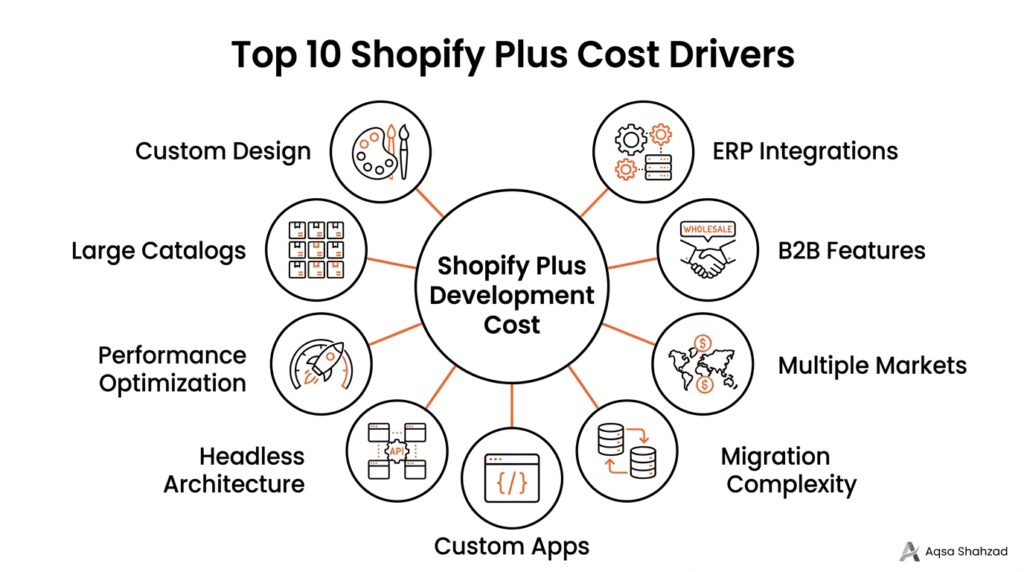
Ten factors explain most of the gap between a $30,000 quote and a $200,000 quote.
- Custom design. Unique templates, animations, and interactive components add design and front-end hours.
- Complex integrations. Two-way ERP syncs with custom business rules are the biggest single variable in most budgets.
- Large product catalogs. Complex variants, metafields, and filtering logic take more data modeling and QA.
- B2B requirements. Pricing tiers, approvals, and payment terms add logic and test cases.
- Multiple markets. Currencies, languages, duties, and localized content add setup and QA. See our approach to international expansion.
- Migration complexity. Messy source data and deep order history take longer to transform and validate.
- Custom apps. Anything that needs its own backend, hosting, and maintenance adds lasting cost.
- Headless architecture. A separate front-end application roughly doubles the engineering involved.
- Performance and QA. Strict speed targets and accessibility standards need dedicated testing time.
- Multiple storefronts. Expansion stores for different brands or regions multiply configuration and content work.
How Much Does It Cost to Hire a Shopify Plus Developer?
In the U.S., Shopify developer rates vary widely by experience and engagement model. Experienced freelancers typically charge $75–$150 per hour. Specialized Shopify Plus developers with checkout extensibility, Functions, and API experience often charge $120–$200 per hour. Agencies usually bill $150–$250+ per hour, or quote fixed project prices that include design, project management, and QA.
When you hire a Shopify Plus developer, the hourly rate matters less than whether they’ve done your kind of work before. A lower-rate developer who has never migrated B2B pricing can easily take twice as long as a specialist. It also helps to compare a specialist’s quote against general Shopify development cost benchmarks. If the gap is large, ask what Plus-specific work explains it. Our Shopify Plus developers can scope your project so you’re comparing like for like.
Shopify Plus Development Agency vs. Developer
The right team depends on the shape of your project. A single developer works well for a clearly defined scope: theme changes, a few custom sections, or a specific integration, especially if you already have design and project management in-house.
A small specialist team, usually a designer, one or two developers, and a QA lead, suits most growth-stage builds. You get specialist skills without the overhead of a large agency.
A full-service Shopify Plus agency makes sense when the project spans design, development, complex integrations, migration, and SEO at once, and someone needs to own the whole timeline. Agencies cost more per hour, but they reduce the coordination work and risk you’d otherwise carry yourself. Shopify’s Partner Directory is useful for checking a partner’s listed specialties.
Shopify Plus Retainer and Ongoing Development Costs
Launch is the start of the store’s working life, not the end of development. Most Plus brands keep investing after go-live: maintenance and bug fixes, app and theme updates, performance tuning, conversion rate optimization tests, new features for upcoming campaigns, and new integrations as the business adds tools.
Retainers commonly run $2,000–$5,000 per month for maintenance and small enhancements, and $5,000–$15,000+ per month for dedicated development and CRO capacity. Working with a Shopify Plus retainer agency gives you reserved hours, faster turnaround, and a team that already knows your codebase, which usually costs less than rebuilding context every time you need help. Our development retainers and support and maintenance plans are structured this way. Brands focused on revenue growth often add Shopify CRO services once the build is stable.
Shopify Plus Development Cost: Realistic U.S. Budget Examples
The examples below are illustrative scenarios built from typical project scopes. They aren’t official Shopify quotes or real client invoices.
Example 1: Focused Custom Store
A U.S. apparel brand moving from Shopify Advanced to Plus with about 300 SKUs, a customized premium theme, Klaviyo and reviews integrations, and no B2B. Estimated build: $30,000–$50,000, delivered in 6–10 weeks.
Example 2: Growth-Stage Shopify Plus Store
A DTC home goods brand migrating from WooCommerce with 2,500 SKUs, a custom theme, a NetSuite integration, subscriptions, and a full SEO migration. Estimated build: $75,000–$120,000 over 12–18 weeks.
Example 3: Enterprise / Complex Replatform
A manufacturer moving off Magento with DTC and B2B on one store, ERP-driven customer pricing, two expansion stores for Canada and the UK, and PIM and WMS integrations. Estimated build: $150,000–$250,000+ over 5–9 months.
Illustrative Line-Item Budget for a Growth-Stage U.S. Brand
Illustrative example only. Not an official Shopify quote.
| Line Item | Estimated Cost |
|---|---|
| Discovery and UX/UI design | $18,000 |
| Custom theme development | $35,000 |
| Data migration (WooCommerce → Shopify Plus) | $14,000 |
| NetSuite integration via middleware | $22,000 |
| Subscription app setup and customization | $6,000 |
| SEO migration and QA | $10,000 |
| Launch and 30-day hypercare support | $5,000 |
| Estimated build total | $110,000 |
| Shopify Plus subscription (year one, 3-yr term) | $27,600 |
| Estimated year-one investment | ~$137,600 + apps |
How to Reduce Shopify Plus Development Cost Without Sacrificing Quality
Most savings come from making decisions early, not from cutting corners. Start by separating launch-critical features from phase-two features. A loyalty program, an advanced bundle builder, or a store locator can usually wait three months after launch without costing you anything.
Use native Shopify functionality before paying for custom work. Native B2B, Shopify Markets, and checkout extensions now cover a lot of what used to need custom builds. Avoid unnecessary custom development, because every custom feature is something you’ll have to maintain. Define integrations early. Discovering in week ten that your ERP can’t expose pricing data the way you assumed is one of the most common causes of budget overruns.
Plan migration before development starts, so data structures and metafields are designed around your real data. Finally, insist on a clear technical scope document. A vague scope leads to change orders, and change orders drive most cost overruns.
How to Choose a Shopify Plus Development Partner
A good partner shows its competence through specifics. Look for proven Shopify Plus experience, not only general Shopify work, and a portfolio with projects similar to yours in size and complexity. Ask about their technical depth with checkout extensibility, Functions, and APIs. Ask how they’ve handled your specific integrations, and whether they’ve managed migrations from your current platform.
If B2B matters to you, ask to see B2B work. Ask how QA is run and who owns it. Ask how they protect SEO during migration, how often they’ll update you, what post-launch support looks like, and how they price changes. Transparent pricing is a good sign. A partner who can’t explain their estimate line by line will be hard to work with when the scope changes. Whether you hire a Shopify Plus developer or a full team, these questions show quickly who has done this work before. Published case studies are a reasonable place to start checking.
When Does Shopify Plus Make Financial Sense?
Shopify Plus isn’t the right fit for every business. Many brands do well on standard Shopify plans for years. Plus starts to pay off when your operations, not only your revenue, outgrow standard Shopify.
The usual signals are scale (high order volume where lower payment rates, the variable fee, and Plus support become valuable), real B2B or wholesale needs beyond Advanced’s three-catalog limit, multiple storefronts for regions or brands, advanced integrations that need higher API limits, checkout customization requirements, and enough operational complexity that automation tools like Shopify Flow save meaningful staff time. If none of those apply, staying on Advanced and putting the difference into your storefront is often the smarter investment for now.
Shopify Plus Development Cost Calculator
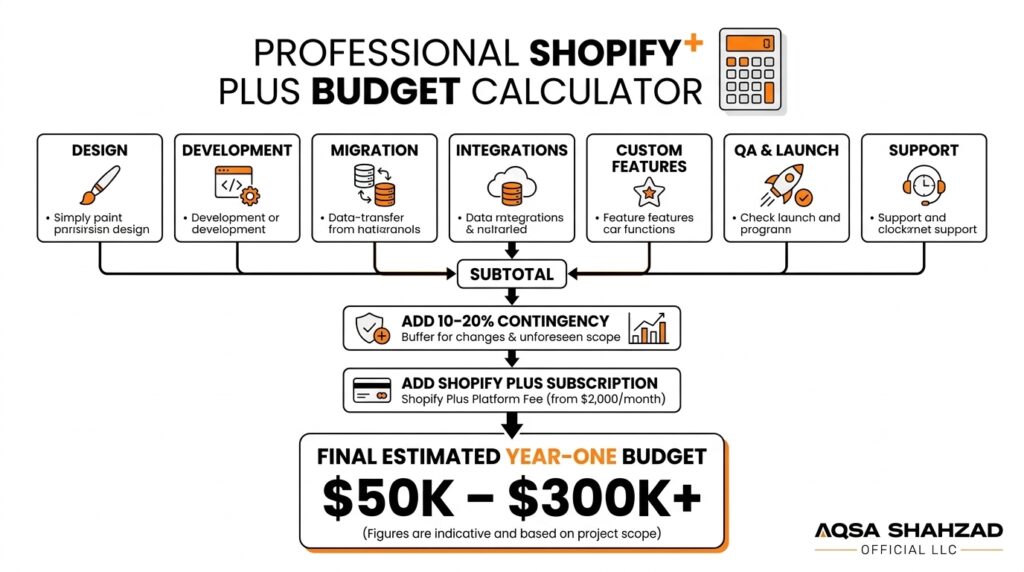
You can build a first-pass budget with one formula:
Total estimated project cost = design + development + migration + integrations + custom functionality + QA/launch + support
Start by listing every system Shopify needs to connect to and assign each one a range. Count the number of unique page templates you need designed. Estimate your data volume: SKUs, customers, orders, and URLs. Add your custom features, then add 10–15% for QA and 10–20% for contingency. Finally, add year-one platform fees and apps for your full first-year investment. For a quicker starting point, our Shopify price calculator can help you estimate before a discovery call.
Questions to Ask Before Accepting a Shopify Plus Development Quote
Before signing, make sure the quote answers these questions:
- Scope: What exactly is included, and what’s explicitly excluded?
- Design: How many templates are designed, and how many revision rounds are included?
- Development: Is this a custom theme or a customized theme? Who maintains the custom code?
- Timeline: What are the milestones, and what happens to the launch date if feedback or data arrives late?
- Migration: Which data types are migrated, and how far back does order history go?
- Integrations: Which systems are included, and who pays for middleware licenses?
- SEO: Is redirect mapping included, and who validates it after launch?
- QA: Which devices, browsers, and checkout scenarios are tested?
- Launch: Is there a launch plan, rollback plan, and hypercare period?
- Support: What happens after launch, and at what rate?
- Ownership: Do you own the code, designs, and app repositories?
- Maintenance: Who handles app and platform updates going forward?
Frequently Asked Questions
How much does Shopify Plus development cost in 2026?
Most U.S. Shopify Plus builds cost $25,000–$150,000. Complex replatforms, B2B implementations with ERP integrations, and headless builds often cost $150,000–$300,000+. These are industry estimates, and your scope sets the final cost.
How much does Shopify Plus cost per month?
Shopify Plus starts at $2,300 per month on a three-year term or $2,500 per month on a one-year term, according to Shopify’s official pricing. Larger businesses may pay a variable, revenue-based platform fee.
Is Shopify Plus development included in the subscription?
No. The subscription covers platform access, hosting, Plus features, and Shopify support. Design, development, migration, and integration work are paid separately to whoever builds your store.
How long does Shopify Plus development take?
Theme customization usually takes 4–8 weeks and a custom Shopify Plus store 8–16 weeks. B2B implementations typically take 12–24 weeks, and headless builds or complex replatforms take 4–9 months.
How much does Shopify Plus migration cost?
Mid-market migrations typically cost $15,000–$40,000. Enterprise migrations with large catalogs, B2B data, or multiple storefronts can cost $75,000 or more, especially when SEO redirect mapping is extensive.
How much does it cost to hire a Shopify Plus developer?
U.S. rates typically range from $75–$150 per hour for experienced freelancers, $120–$200 per hour for Plus specialists, and $150–$250+ per hour for agencies. Retainers usually run $2,000–$15,000+ per month.
Final Shopify Plus Development Cost Breakdown
Shopify Plus development cost usually falls between $25,000 and $150,000 for the initial build, with enterprise and headless projects going past $150,000–$300,000+. The platform itself starts at $2,300–$2,500 per month under Shopify’s official pricing, compared with $299–$399 per month for Shopify Advanced, and that’s separate from any build cost. Most projects take 8–16 weeks, while B2B, headless, and enterprise work runs from three to nine months.
The biggest cost drivers are custom design, integrations, catalog size, and migration complexity. Migration usually adds $15,000–$75,000+, and ERP-level integrations can add $20,000–$60,000+ each. B2B builds range from light native setups to six-figure implementations, headless adds a separate front-end application to build and maintain, and ongoing support usually costs $2,000–$15,000+ per month.
The brands that stay on budget are the ones that scope carefully, use native features where they can, and treat migration and integrations as real line items from the start. If you’re planning a build, migration, or B2B rollout and want a clear, itemized estimate, our Shopify Plus development services start with a scoping conversation, not a sales pitch. You can get in touch here when you’re ready.