
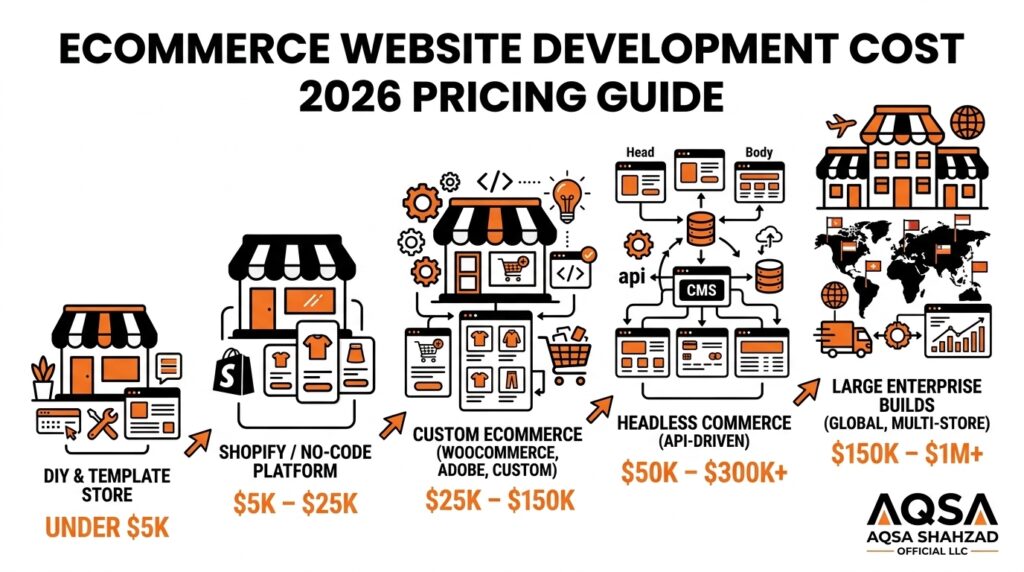
Most professionally built ecommerce websites in the U.S. cost an estimated $5,000 to $150,000. DIY stores can come in under $5,000, and headless or enterprise rebuilds often run well past $150,000. The range is wide because “ecommerce website” covers very different projects. A 40-product Shopify store and a 60,000-SKU B2B catalog synced to an ERP share a name, not a scope.
The final ecommerce website development cost mostly depends on six things: the platform, how much custom functionality you need, how many systems the store must connect to, how complex your catalog is, whether you’re migrating data, and who builds it.
This guide is for U.S. founders, ecommerce managers and operations leads who are budgeting a new store, a redesign or a replatform. You’ll find estimated cost ranges by project type, business size, catalog size and budget, plus hidden costs, sample project budgets and the questions to ask before you sign a quote.
Key Takeaways
- Typical range: most professional U.S. ecommerce builds cost an estimated $5,000–$150,000. Headless and enterprise projects often exceed $150,000.
- Scope drives price more than platform does. Integrations, data migration, custom features and catalog complexity usually move the number more than subscription fees.
- Platform fees and development are separate. Shopify plans start at $39/month (billed monthly), but the build on top is a separate one-time cost.
- Budget for what’s easy to miss: product data cleanup, photography, copy, apps, redirects, QA, training and your own team’s time.
- Plan recurring costs. Platform fees, apps, payment processing and maintenance continue after launch. Many teams set aside roughly 15–20% of the build cost per year for upkeep (a rule of thumb, not a standard).
- Go custom only when your business logic doesn’t fit a platform, not just to look different.
- A good quote itemizes templates, features, integrations, migration, QA, SEO and post-launch support, so you can compare it with others.
How Much Does an Ecommerce Website Cost in 2026?
A professionally built ecommerce website in the U.S. typically costs somewhere between $5,000 and $150,000. That range covers everything from a lightly customized theme to a fully custom storefront with multiple integrations.
There isn’t one universal ecommerce website price because stores are priced on labor, and labor scales with complexity. Each extra requirement adds hours of design, development and testing: a subscription model, a product builder, wholesale pricing, a sync with NetSuite. The table below shows typical estimated ranges. These are market estimates based on common U.S. project scopes, not official prices, and a specific quote can land outside them.
| Project type | Estimated cost (USD) | Typical timeline (estimated) | Best suited for | Main cost drivers |
|---|---|---|---|---|
| Basic ecommerce website (DIY/template) | Under $5,000 | 1–4 weeks | New brands testing a product | Theme choice, apps, your own time |
| Small business ecommerce store | $5,000–$25,000 | 4–10 weeks | Established small brands, modest catalogs | Theme customization, product setup, basic integrations |
| Shopify / Shopify Plus custom build | $25,000–$150,000 | 2–5 months | Growing DTC and B2B brands | Custom theme, checkout customization, apps, migration |
| Custom ecommerce website | $50,000–$250,000+ | 3–9 months | Unique business logic or workflows | Custom backend, admin tools, integrations |
| Headless commerce | $80,000–$300,000+ | 4–9 months | Content-heavy or performance-focused brands | Separate frontend, CMS, APIs, hosting |
| Enterprise ecommerce rebuild | $150,000–$1,000,000+ | 6–18 months | Large catalogs, multiple markets, ERP-driven ops | Data migration, ERP/CRM/PIM, multi-region, security |
Timelines assume a reasonably prepared client. Delays in content, product data or approvals are among the most common reasons projects run long and over budget.
What Each Budget Band Typically Buys
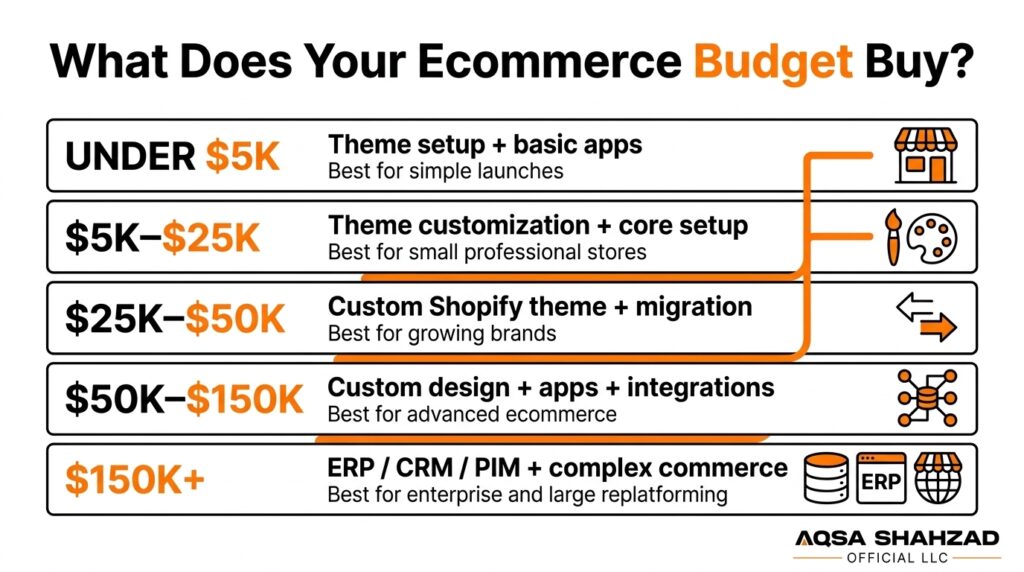
| Budget (estimated) | What it typically covers | What it usually doesn’t |
|---|---|---|
| Under $5K | Premium theme with light setup, standard apps, owner-entered products, basic shipping and tax | Custom design, integrations beyond apps, migration of order history |
| $5K–$25K | Professional theme customization, a few custom sections, product import, payment/shipping/tax setup, email and analytics | Custom apps, ERP or 3PL integrations, complex migrations |
| $25K–$50K | Custom Shopify theme, custom product and collection features, a standard migration with redirects, one or two app-based integrations | Custom middleware, B2B pricing logic, multi-region setup |
| $50K–$150K | Custom design system, custom apps, 3PL or subscription integrations, larger migrations, Shopify Plus checkout and B2B features | Full ERP-driven operations, several brands or regions at once |
| $150K+ | ERP/CRM/PIM integration, complex B2B pricing, multi-region stores, headless storefronts, phased enterprise replatforming | Nothing is standard here. Discovery sets the scope |
Want a number for your own scope? Our ecommerce price calculator lets you choose your platform, features and integrations and see an estimated budget in a couple of minutes.
Ecommerce Website Development Cost by Project Type
Basic Ecommerce Website
A basic store runs on a hosted platform with a free or premium theme, a handful of apps and products entered by the owner. Out-of-pocket cost is often under $5,000, and sometimes under $1,000 if you do the work yourself. The real cost is your time: design decisions, product copy, shipping rules and app troubleshooting. For a brand validating a product idea, that trade-off often makes sense.
Small Business Ecommerce Website
This is the most common professional project. A developer or small team customizes a premium theme to fit your brand, builds a few custom sections, configures shipping, taxes and payments, loads products and connects email marketing and analytics. Expect an estimated $5,000–$25,000. Cost goes up with the number of unique page templates, custom product page features (bundles, swatches, size guides) and how clean your product data is.
Shopify Ecommerce Website
Shopify ecommerce development cost depends on how far you move from the theme. A tailored theme with custom sections might sit at $15,000–$40,000. A fully custom Online Store 2.0 theme with custom apps, metafield-driven content and third-party integrations often runs $40,000–$150,000 (estimated). On Shopify Plus, extra work usually comes from checkout customization, B2B features, multiple storefronts and automation with Shopify Flow or custom apps. If you’re planning a larger build, it helps to see what custom Shopify Plus development covers beyond the theme itself.
Custom Ecommerce Website
A custom store is built on a framework or open-source platform where your team owns the codebase and often the hosting. Estimated costs usually start around $50,000 and can pass $250,000. You pay for everything a SaaS platform would otherwise give you: cart and checkout logic, admin screens, security hardening, performance tuning and ongoing patching. The upside is full control. The downside is that every feature is yours to build and maintain.
Headless Ecommerce Website
Headless commerce separates the customer-facing frontend (often React or Next.js, or Shopify Hydrogen) from the commerce backend, which connects through APIs. Headless commerce cost is higher because you’re effectively building and hosting two systems, usually plus a headless CMS. Estimated builds often run $80,000–$300,000+, and ongoing costs rise too, since the frontend needs its own hosting, monitoring and developer support. Headless can deliver excellent performance and content flexibility, but it isn’t automatically better. A strong theme build handles most stores well, and a specialist in headless Shopify development should be willing to tell you when you don’t need it.
Enterprise Ecommerce Website
Enterprise builds serve large catalogs, multiple regions and deep back-office integration. Estimated budgets commonly start around $150,000. The enterprise rebuild section below explains where that money goes.
Cost by Business Stage
Business size changes the requirements more than the platform does. Larger companies usually have more systems, more stakeholders and less tolerance for launch risk.
| Business stage | Typical requirements | Estimated build range |
|---|---|---|
| New or small brand | Theme-based store, core apps, owner-managed content | Under $5K–$25K |
| Established DTC brand | Custom theme, subscriptions or bundles, email/SMS, reviews, a migration | $25K–$150K |
| Mid-market retailer | Shopify Plus, 3PL/ERP connections, multiple storefronts or currencies, stronger QA | $75K–$250K |
| B2B / wholesale | Company accounts, customer-specific pricing, net terms, quick order, ERP sync | $50K–$300K+ |
| Enterprise | Multiple brands or regions, deep integration, compliance, phased rollout | $150K–$1M+ |
What Affects Ecommerce Website Development Cost?
A useful way to think about cost: every requirement adds design, build, test and maintenance time. A single phrase in a brief can become several weeks of work. “Customers should see their own negotiated prices” is one example. The factors below explain most of the gap between a $10,000 quote and a $100,000 one.
Platform Selection
Your platform sets the baseline. Hosted SaaS platforms like Shopify include hosting, security patches, PCI-compliant checkout and core commerce features, so development focuses on your storefront and integrations. Open-source and custom platforms give you more control but require you to build, configure and maintain far more. Shopify’s official pricing page lists U.S. plans from $39/month (Basic) to $399/month (Advanced) when billed monthly, with lower rates on yearly billing. Shopify Plus is listed at $2,500/month on a one-year term or $2,300/month on a three-year term, and Shopify notes that more complex, higher-volume businesses may pay a variable platform fee based on revenue instead.
Design and UX
A customized premium theme costs far less than original UX research, wireframes and a bespoke design system. Custom design is worth it when your products need unusual presentation, such as configurators, rich comparison tools or complex collection filtering. Because a large share of shoppers browse on mobile, professional ecommerce UX/UI design usually puts its budget into mobile filters, product pages and the path to checkout. That work tends to matter more than decorative design.
Custom Functionality
This is where budgets grow fastest. Subscriptions, bundles, product customizers, quote requests, loyalty logic, gated wholesale catalogs and custom checkout rules all add scope. Apps can handle many of these, so check before building from scratch.
App stacks have a cost of their own, though. Each app adds a monthly subscription, often loads extra scripts on the storefront, and can overlap with other apps. Three apps modifying the same product page is a common source of slow load times and hard-to-trace bugs. When no app fits, or several are fighting each other, custom app development can replace them with one purpose-built tool, at a higher upfront cost.
Product Catalog Size
SKU count is a poor cost predictor on its own. What drives effort is how products are structured: variants, options that depend on other options, customer-specific pricing, compatibility data and how shoppers need to filter. Use SKU count as a starting point, then adjust for complexity.
| Catalog size | Typical approach | What makes it harder |
|---|---|---|
| 1–50 products | Manual entry, simple collections | Custom bundles or configurators |
| 51–500 | CSV import, structured metafields, basic filtering | Deep variants, inconsistent supplier data |
| 501–5,000 | Bulk import scripts, faceted search, a data cleanup pass | Multiple price lists, region-specific assortments |
| 5,001–50,000 | PIM or ERP as the source of truth, automated sync, dedicated search | Fitment/compatibility data, per-customer B2B catalogs |
| 50,000+ | Integration-led architecture, API rate-limit planning, search tuning | Multiple data sources, frequent price and stock changes |
For example, 300 rings with metal, stone, size and engraving options can take more work than 8,000 simple SKUs with one variant each. The rings need option logic, validation and a product page that makes choosing easy.
Payment Gateway Integration
On hosted platforms, standard gateways are mostly configuration. Cost rises with non-standard needs: multiple gateways, buy-now-pay-later, ACH or net-terms invoicing for B2B, stored payment methods for subscriptions, or high-risk merchant accounts. Transaction fees are a separate recurring cost. For reference, Stripe’s standard U.S. pricing for domestic online card payments is 2.9% + 30¢ per successful transaction.
Integrations and APIs
Most stores connect to email/SMS, reviews, analytics, shipping and tax tools. Larger businesses add ERP (NetSuite, Microsoft Dynamics, Acumatica), CRM (Salesforce, HubSpot), 3PL and PIM systems. Cost depends less on which system and more on how much has to sync, in which direction, and what happens when something fails.
| If you need… | Expect… |
|---|---|
| Email or reviews connected through an existing app | Configuration measured in hours |
| One-way order export to a 3PL through an existing connector | Setup plus testing of edge cases like split shipments and cancellations |
| Two-way inventory sync across warehouses | Custom mapping, scheduling, conflict rules and monitoring |
| ERP sync of orders, inventory, customer-specific pricing and invoices | Custom middleware or an integration platform, error handling, retries, logging and a full QA cycle, often one of the largest line items |
ERP integrations are expensive for a practical reason. The ERP is usually the source of truth for pricing and stock, and it has its own data model. Every mismatch, whether units of measure, bundles, tax codes or customer hierarchies, has to be mapped and tested. When an order fails to sync at 2 a.m., someone needs to know, which is why logging and alerts belong in scope.
Migration
Ecommerce migration cost depends on what you’re moving: products, customers, order history, gift cards, reviews, URLs and SEO redirects. A typical migration runs in this order:
- Export and audit the source data.
- Clean it and map it to the new platform’s structure.
- Run a test migration.
- Check a sample of products, customers and orders by hand.
- Build the redirect map.
- Run the final migration close to launch.
Redirects should be mapped before migration, because the old URL list is easiest to capture while the old site is still live. Data quality drives the cost. If titles, variants and attributes are consistent, most of the work can be scripted. If the same attribute is stored three different ways across 4,000 products, someone has to clean it, and that time belongs in the budget. A dedicated ecommerce platform migration plan should cover data mapping, redirects and a test run before go-live.
SEO Requirements
A developer who understands ecommerce SEO handles clean URL structures, canonical tags, structured data, page speed, crawlable filtering and redirects as part of the build. Retrofitting these after launch usually costs more, so treat technical SEO as part of development scope rather than an add-on.
Testing and Quality Assurance
QA covers cross-browser and device testing, integration testing, accessibility checks and performance testing. Checkout testing should cover real scenarios, not just one test order:
- discount codes combined with free shipping
- a failed card followed by a retry
- gift cards and subscriptions
- tax in several states
- a partial refund
- an order flowing through to the 3PL or ERP
Cutting QA is a false economy. A checkout bug found after launch costs lost orders plus emergency development fees.
Maintenance and Support
Stores need platform updates, app changes, bug fixes, security monitoring and small improvements. Hosted platforms reduce the infrastructure burden. Custom and headless stores need more active maintenance because you own more of the stack.
Ecommerce Website Development Cost Breakdown
Every project divides its budget differently, so a fixed percentage split would be misleading. A migration-heavy enterprise rebuild might spend more on data and integration than on design, and a new DTC brand might do the opposite. This table shows how much each phase tends to take relative to the others.
| Phase | What it includes | Relative budget weight |
|---|---|---|
| Discovery and planning | Requirements, technical audit, integration mapping, sitemap, scope document | Low to medium, but reduces risk everywhere else |
| UX/UI design | Wireframes, visual design, design system, mobile layouts | Medium (higher for fully custom design) |
| Frontend development | Theme or storefront build, templates, interactive components | High |
| Backend development | Custom logic, apps, admin tools, checkout rules | Low on SaaS themes; high on custom builds |
| Integrations | ERP, CRM, 3PL, PIM, marketing tools, APIs | Low for small stores; often the largest item for enterprise |
| Migration | Products, customers, orders, redirects, data cleanup | Varies widely with data quality |
| Testing/QA | Functional, device, checkout, integration, accessibility testing | Medium |
| SEO | Technical SEO, structured data, redirects, speed | Low to medium |
| Launch | Go-live plan, DNS, monitoring, post-launch fixes | Low |
| Ongoing support | Maintenance, updates, improvements | Recurring, budgeted separately |
A good proposal breaks costs down by these phases rather than giving one lump sum. That makes quotes easier to compare and shows which requirements are driving the price.
Ecommerce Development Agency vs Freelancer
The ecommerce development agency vs freelancer decision is mostly about risk, scope and coordination, not only hourly rate.
Freelancers usually charge less per hour, and a strong specialist can be the most efficient option for a theme customization, a single integration or ongoing small tasks. For context on U.S. labor costs, the U.S. Bureau of Labor Statistics reports a May 2025 median wage of $47.85 per hour for web developers and digital designers. That’s a salaried-employee figure. Independent freelancers and agencies charge more to cover benefits, tools, non-billable time and overhead. As a rough market estimate, not a published statistic, U.S. freelance ecommerce rates often fall around $50–$150 per hour and agency rates around $100–$250 per hour, depending on specialization and seniority.
Agencies cost more per hour but typically bring a team: strategy, UX, frontend, backend, QA and project management. That matters on larger projects, where one person can’t cover every discipline and continuity is important.
A simple way to sanity-check any quote is estimated hours × blended hourly rate + contingency. For example, a 300-hour project at a blended $150/hour is $45,000, and a 15% contingency brings the budget to about $51,750. The hours and rate here are illustrative. Use the formula to compare quotes on the same basis, not to predict a price.
| Factor | Freelancer | Agency |
|---|---|---|
| Typical cost | Lower hourly rate | Higher hourly rate, broader team |
| Best fit | Defined, smaller scopes; ongoing tweaks | Multi-discipline builds, migrations, integrations |
| Project management | Often handled by you | Usually included |
| Scalability | Limited by one person’s capacity | Can add people as scope grows |
| Continuity | Risk if the person becomes unavailable | Team coverage and documentation |
| Ongoing support | Varies by individual | Often offered as retainers |
Neither option is universally better. A $15,000 theme project may be better served by an experienced freelancer. A $120,000 replatform with ERP integration usually needs a coordinated team.
Shopify vs Custom Ecommerce Website Cost
Comparing platforms by monthly fees alone misses most of the picture. What matters is total cost of ownership: platform fees, development, apps, hosting, maintenance, payment processing and internal time over three to five years.
| Approach | Platform cost | Typical build cost (estimated) | Maintenance burden | Best fit |
|---|---|---|---|---|
| Shopify | $39–$399/month billed monthly (official) | $5K–$75K | Low: hosting and security handled | Small to mid-size DTC |
| Shopify Plus | $2,300–$2,500/month, or a variable fee (official) | $40K–$250K+ | Low to medium | Mid-market, B2B, multi-store |
| Open-source (WooCommerce, Adobe Commerce) | Low or no license; you pay for hosting and extensions | $15K–$250K+ | Medium to high: updates, security, hosting | Teams with in-house developers |
| Custom build | Hosting and infrastructure | $50K–$250K+ | High: you own the whole stack | Unusual business logic |
| Headless (any backend) | Backend plan + frontend hosting + CMS | $80K–$300K+ | High: two systems to maintain | Content-heavy, performance-focused brands |
Worked example: first-year cost on Shopify Grow (illustrative). A brand builds a $40,000 custom theme and does $1,000,000 in online sales at an $80 average order (about 12,500 orders).
- Platform: Grow billed yearly at $79/month comes to $948.
- Apps: assume $300/month, or $3,600.
- Card processing: at Shopify Payments’ Grow online rate of 2.7% + 30¢, that’s $27,000 + (12,500 × $0.30 = $3,750), or about $30,750.
- Maintenance: assume 15% of the build, or $6,000.
Year one, excluding the build, comes to roughly $41,300. Payment processing is by far the largest part, and the plan fee is the smallest. That’s why subscription price alone is a poor way to compare platforms.
Enterprise Ecommerce Rebuild Cost
Enterprise ecommerce rebuild cost is often several times that of a standard store, and the reason is rarely the storefront. The complexity sits in the systems, data and processes behind it.
Replatforming at this level means migrating years of product, customer and order data, often from a legacy platform with custom fields and inconsistent records. ERP and CRM integrations must handle inventory across warehouses, customer-specific pricing, order routing, returns and invoicing, reliably and at volume. Complex catalogs may involve configurable products, compatibility data and multiple price books. Selling in multiple markets adds currencies, languages, tax rules and region-specific content.
B2B pricing changes the architecture, not just the storefront. Once each company account can have its own price list, payment terms and catalog, pricing can’t live only in the product record. It has to come from rules or from the ERP, and every place that shows a price has to respect them: search results, cart, quick order and checkout. That affects data modeling, integration design, caching and QA. For wholesale-heavy businesses, B2B commerce features like company accounts, net terms and quick-order forms are a scope layer of their own.
Performance and security requirements are stricter too. Peak-season traffic, such as Black Friday for U.S. retailers, must be load-tested, and a BFCM readiness audit is one way to find weak points early. Access controls, audit trails and compliance reviews take time. Custom workflows for approvals, quotes, account hierarchies and sales-rep ordering must be designed, built and tested, and the project needs dedicated project and change management because many internal teams depend on the result.
Put together, a mid-market replatform might land in the low-to-mid six figures (estimated), while a large multi-brand, multi-region program can reach seven figures. Phased delivery, launching core commerce first and adding integrations and markets after, is a common way to manage both risk and cash flow.
Ecommerce Website Ongoing Costs
Development is a one-time (or phase-based) cost. Owning the store is recurring. Separating the two keeps budgets honest and prevents surprises in year one.
| Recurring cost | What it covers | Estimated range |
|---|---|---|
| Platform/hosting | SaaS subscription or cloud hosting | Official plan pricing on SaaS; varies on custom |
| Apps/plugins | Reviews, subscriptions, search, loyalty, etc. | Often $50–$1,000+/month combined (estimate) |
| Payment processing | Per-transaction card fees | Percentage + fixed fee per order |
| Maintenance and support | Updates, fixes, small improvements | Retainer or hourly; commonly 15–20% of build cost per year (rule of thumb) |
| Security | Monitoring, SSL, access reviews, patching (custom stores) | Higher on self-hosted stacks |
| SEO | Technical fixes, content, collection optimization | Varies by scope |
| Analytics and CRO | Tracking, testing, UX improvements | Varies by scope |
| Content/product management | New products, merchandising, campaigns | Often internal staff time |
[INFOGRAPHIC 4 — ecommerce-one-time-vs-recurring-costs.png — Alt: “One-time ecommerce development costs compared with recurring costs after launch”]
Many brands handle maintenance through a monthly support and maintenance retainer instead of paying ad hoc, which makes costs predictable. A store that launches and is left alone usually declines over time as apps, browsers and customer expectations change.
How to Create an Ecommerce Website Development Budget
A realistic budget starts with requirements, not a number you hope to hit. Work through these nine areas and estimate each one:
- Core platform: annual subscription or hosting, plus a premium theme if applicable.
- Design: customized theme or fully custom UX/UI.
- Development: templates, custom features, apps.
- Integrations: every system the store must talk to, and whether a connector exists.
- Migration: products, customers, orders, redirects, and how clean that data is today.
- SEO: technical setup, redirects, structured data.
- Testing: QA time in proportion to complexity.
- Launch: go-live support and a post-launch fix window.
- Maintenance: first-year retainer or support hours.
Then add a contingency of roughly 10–20% (a planning guideline) for complexity you discover along the way. Something is almost always discovered.
Hidden Costs Buyers Often Miss
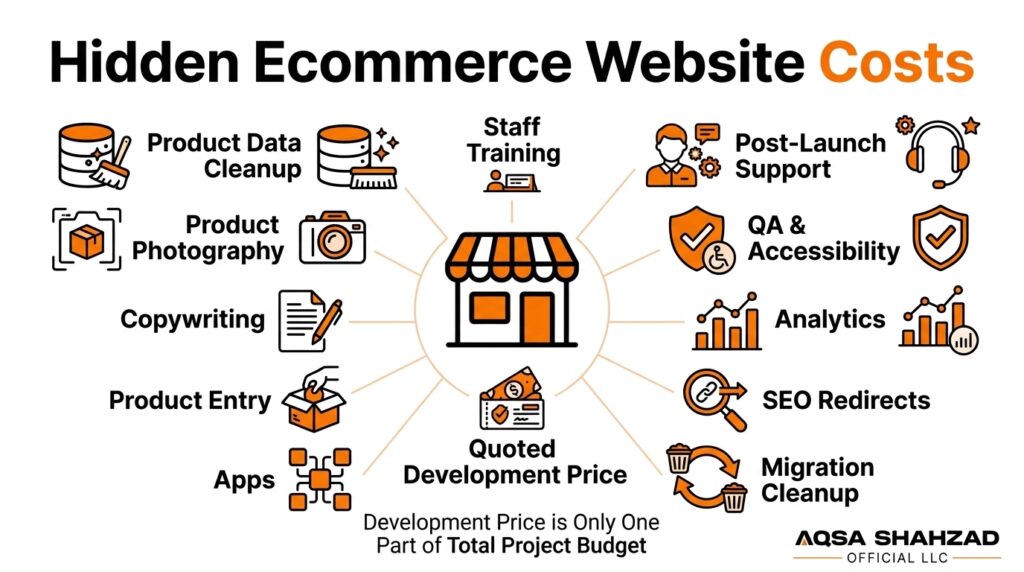
Many budget overruns don’t come from development at all. They come from work nobody listed in the brief.
| Cost | Why it’s missed | Who usually pays for it |
|---|---|---|
| Product data cleanup | Assumed to “just import” | Your team, or the developer by the hour |
| Product photography | Existing photos don’t fit the new design | Photographer or studio |
| Copywriting | Product, collection and policy copy for new templates | Copywriter or internal team |
| Product entry | Excluded from many quotes | Your team, a VA, or the developer |
| Premium theme | Not in the development fee | One-time purchase |
| Apps | Added one by one during the build | Monthly subscriptions |
| Payment processing | Treated as “not a website cost” | Per-transaction fees |
| Shipping and tax setup | Multi-state tax and carrier rules take time | Developer or operations team |
| Migration cleanup | Old data surfaces problems | Developer, by the hour |
| SEO redirects | Left until the last week | Developer or SEO |
| Analytics setup | GA4, pixels and consent tracking | Developer or analytics specialist |
| QA | Compressed when timelines slip | Developer, plus your team for acceptance testing |
| Accessibility | Checked after launch, if at all | Developer or auditor |
| Post-launch support | Quote ends at go-live | Retainer or hourly |
| Training | Staff need to learn the admin | Developer or internal lead |
| Internal project time | Approvals, content and testing | Your team’s hours |
[INFOGRAPHIC 5 — ecommerce-hidden-costs-checklist.png — Alt: “Checklist of hidden ecommerce website costs buyers often overlook”]
Sample Project Budgets
The four scenarios below are illustrative estimates, not quotes. They show how requirements, more than platform, change the number.
| Launch-stage DTC | Established DTC replatform | Mid-market Shopify Plus | B2B distributor | |
|---|---|---|---|---|
| Business | New apparel brand | Home goods brand leaving WooCommerce | Beauty brand selling in 2 regions | Industrial parts distributor |
| Products | ~80 | ~2,000 SKUs | ~1,200 SKUs with bundles | ~25,000 SKUs |
| Platform | Shopify | Shopify | Shopify Plus | Shopify Plus (B2B) |
| Design | Premium theme, customized | Custom theme | Custom design system | Functional, B2B-first UX |
| Integrations | Email/SMS, reviews | 3PL, subscriptions | 3PL, loyalty, ERP (orders + inventory) | Two-way ERP (pricing, stock, invoices), CRM |
| Migration | None | Products, customers, orders, redirects | Products, customers, redirects | Customers, companies, catalog, redirects |
| Custom features | A few custom sections | Bundle builder | Multi-market setup, checkout customization | Customer-specific pricing, quick order, net terms, rep ordering |
| Estimated range | $10K–$25K | $50K–$110K | $90K–$200K | $150K–$350K+ |
| Main cost drivers | Design polish, product setup | Data cleanup, migration, subscriptions | Integrations, multi-region, QA | ERP mapping, pricing logic, testing |
| Timeline (estimated) | 4–8 weeks | 3–5 months | 4–6 months | 6–12 months, often phased |
To model your own mix, the price calculator gives a starting estimate you can bring into conversations with developers.
How to Compare Ecommerce Development Quotes
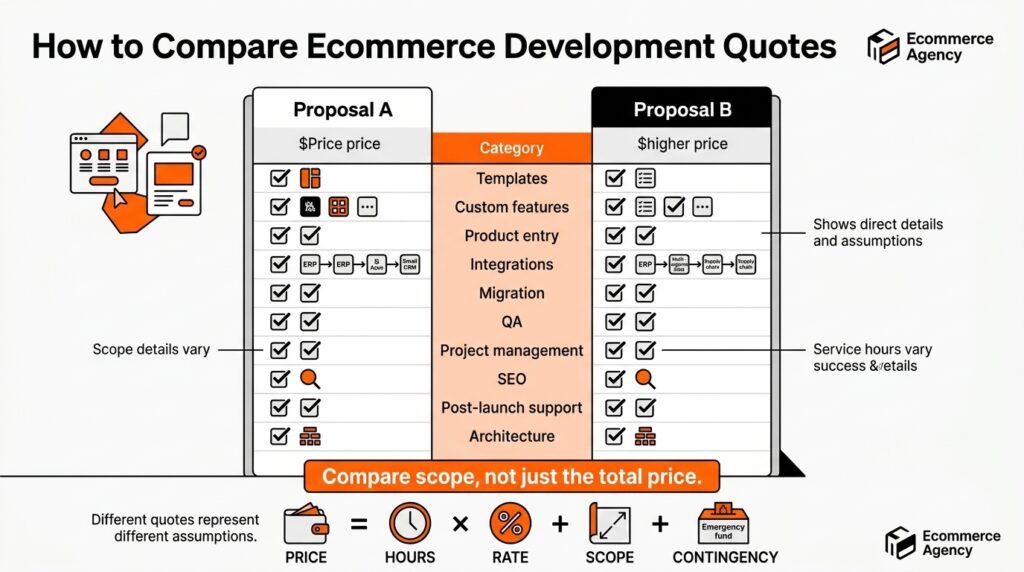
Why Two Quotes for the Same Store Can Differ by 3x
Two agencies can read the same brief and price it very differently, usually because they’re pricing different assumptions. Before comparing totals, line the quotes up on these points:
| Line item | A lower quote often assumes | A higher quote often includes |
|---|---|---|
| Templates | Home, collection, product, cart only | Every unique page type, including landing and account pages |
| Custom features | Apps will cover it | Custom builds where apps fall short |
| Product entry | You do it | Import scripts and data cleanup |
| Integrations | Existing connectors, one-way | Two-way sync, error handling, monitoring |
| Migration | Products only | Customers, orders, reviews, redirects, test runs |
| QA | Developer self-testing | Dedicated QA, device matrix, checkout scenarios |
| Project management | Minimal | Weekly check-ins, documentation, a named PM |
| SEO | Not mentioned | Redirects, structured data, speed checks |
| Post-launch | Ends at go-live | 30–90 days of fixes, then a retainer option |
| Architecture | Theme + apps | Custom apps, headless, or middleware |
Neither column is automatically right. A lower quote can be a good fit if its assumptions match your needs. The risk comes from assumptions that aren’t written down.
Questions to Ask Before Accepting a Quote
- Which page templates are included, and how many?
- Which features are custom-built and which rely on apps? What will those apps cost each month?
- Who enters and cleans product data?
- Exactly what data is migrated, and is there a test migration?
- Who builds and tests the redirect map?
- How are integrations tested, and what happens when a sync fails?
- What does QA cover, and on which devices and browsers?
- Is accessibility checked, and against which standard?
- How are change requests priced?
- What support is included after launch, and for how long?
- Who owns the code, theme and accounts at the end of the project?
- Can we see a comparable project and speak to that client?
How to Reduce Ecommerce Website Development Costs Without Cutting Quality
The most reliable savings come from reducing uncertainty, not quality.
- Define scope early. A paid discovery phase often saves more than it costs, because it keeps assumptions from turning into change requests.
- Launch with an MVP. Separate “needed on day one” from “phase two.” Many features are better designed once you have real customer data.
- Reuse proven components. Well-supported apps and theme sections can replace custom code when they meet the requirement.
- Avoid custom for its own sake. A bespoke feature should earn its place through revenue, efficiency or customer experience.
- Plan integrations up front. Late integration discoveries are one of the most common causes of overruns.
- Prepare your data. Cleaning product and customer data before migration is cheaper than having developers work around it.
Don’t cut security, accessibility, SEO foundations, mobile UX or testing to hit a number. Those savings usually come back as bigger costs later.
When Should You Invest in Custom Ecommerce Development?
Custom development makes sense when your business model doesn’t fit a platform’s standard behavior, and working around that limitation costs you revenue or efficiency. Common signals:
- Complex business logic, such as tiered B2B pricing, quote-to-order flows or rules that change price by account, region or quantity.
- Unique customer journeys, like product configurators, subscription builders or guided selling.
- Advanced integrations where orders, inventory and customer data must stay in sync across ERP, CRM, PIM and fulfillment.
- Enterprise workflows like approvals, account hierarchies and sales-rep ordering.
- Performance requirements at high traffic or with very large catalogs.
- Unusual catalog structures, including compatibility data, made-to-order products or deeply nested variants.
- Advanced personalization driven by customer data.
- Scalability requirements tied to international expansion or multiple brands.
Custom rarely means building everything from scratch. Often the most cost-effective approach is a proven platform like Shopify Plus, extended with custom apps, integrations and storefront features where they add real value. That’s the scoping and build work professional ecommerce development services typically cover: deciding what to configure, what to extend and what to build.
Frequently Asked Questions
How much does it cost to build an ecommerce website?
Most professionally built U.S. ecommerce websites cost an estimated $5,000 to $150,000. Simple DIY stores can cost under $5,000, while headless and enterprise builds can exceed $150,000. Ecommerce website development cost depends mainly on custom features, integrations, migration and catalog complexity.
How much does a custom ecommerce website cost?
A custom ecommerce website typically starts around $50,000 and can exceed $250,000 (estimated). It costs more because custom builds include checkout logic, admin tools, security and hosting that SaaS platforms otherwise provide, and those systems need ongoing maintenance.
How much does Shopify ecommerce development cost?
Shopify development usually costs an estimated $5,000–$25,000 for a customized theme and $25,000–$150,000 for a custom theme or Shopify Plus build. Platform fees are separate: Shopify’s U.S. plans start at $39/month billed monthly, and Shopify Plus starts at $2,300/month on a three-year term ($2,500/month on a one-year term).
How much does an ecommerce website cost per year?
Annual costs usually include platform or hosting fees, apps, payment processing, and maintenance and development support. Many businesses plan roughly 15–20% of the original build cost per year for maintenance and improvements (a rule of thumb), plus platform, app and transaction fees that grow with the store.
Is it cheaper to hire a freelancer or an ecommerce development agency?
A freelancer is usually cheaper per hour, and an agency is usually more cost-effective for complex, multi-discipline projects. Freelancers suit smaller, well-defined scopes. Agencies combine design, development, QA and project management, which lowers risk on migrations, integrations and larger builds.
What’s usually not included in an ecommerce development quote?
Product photography, copywriting, product entry, app subscriptions, platform fees, payment processing and post-launch support are often excluded unless the quote lists them. Ask for a written list of inclusions and exclusions before signing, because these items can add a meaningful share to the total project cost.
How We Estimated These Prices
Platform subscription and payment processing figures come directly from official sources (Shopify and Stripe pricing pages, checked September 2026). Labor wage data comes from the U.S. Bureau of Labor Statistics. Development cost ranges, timelines and sample budgets are estimates, not official prices. They reflect typical U.S. project scopes, and your quote may fall above or below them depending on requirements, timeline and team. We update this guide when platform pricing changes.
Final Thoughts
The right ecommerce website development cost is the one that matches your requirements. A store that’s too simple limits growth, and one that’s over-built wastes budget and adds maintenance. Start by listing what the store must do on day one, which systems it must connect to and what data needs to move. Those answers will narrow any price range faster than comparing quotes.
If you’d like a second opinion on scope, platform choice or budget before committing, you can talk through your project with a Shopify Plus engineer and get a clearer picture of what your store needs.